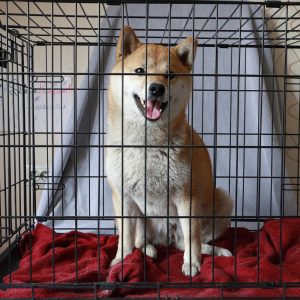
A dog who loves the crate is a dog who stays safe and calm when a storm arrives. Positive crate training in July makes September easier for everyone.
Every June, South Florida runs through the same checklist. Shutters, water, batteries, gas for the generator. Somewhere near the bottom of that list, if it makes the list at all, is the dog.
Here is the thing most hurricane preparedness for dogs articles will not tell you: the supplies are the easy part. You can buy a crate, a leash, and a two-week supply of food in a single afternoon. What you cannot buy the day before a storm is a dog who is comfortable using any of it.
That part takes training. And the best time to start is right now, in July, while the tropics are quiet and you have weeks of calm weather to work with. Because when a storm is spinning in the Atlantic and the cone shifts toward Miami-Dade, it is too late to teach your dog anything new. In September, you will only have the skills you built in July.
Why Hurricane Preparedness for Dogs Starts With Training.
When we think about hurricane prep, we think about stuff. But for your dog, a hurricane is not a supply problem. It is a behavior problem.
Think about what a storm actually asks of your dog. Hours or days of confinement, possibly in a crate. Loud, unpredictable noise from wind, rain, and flying debris. A house full of stressed humans. Potty breaks in a garage, on a patio, or on a puppy pad instead of the usual grass. Maybe an evacuation to a shelter, a hotel, or a relative’s house full of unfamiliar people and pets.
Every single one of those is a trainable skill. And every single one of them falls apart under stress if your dog is encountering it for the first time during the actual emergency.
Dogs do not generalize well, and they do not learn well when they are scared. A dog who has never been crated will not suddenly accept a crate while a Category 3 storm rattles the shutters. A dog who has only ever pottied on grass will hold it, sometimes to the point of a medical issue, rather than go on concrete. Stress narrows a dog’s ability to cope. Preparation widens it.
That is why hurricane preparedness for dogs is a training project first and a shopping trip second.
Skill One: A Crate That Feels Like Home, Not a Trap
If your dog learns only one thing before hurricane season peaks, make it this one. Crate comfort is the cornerstone of hurricane preparedness for dogs.
During a storm, the safest place for your dog is often a crate in an interior room, away from windows. If you evacuate, most emergency shelters that accept pets require dogs to be crated. Hotels often require it too. A dog who panics in a crate is a dog whose safest option is off the table.
Force-free crate training is not about shutting the door and letting your dog “get used to it.” That approach teaches your dog that the crate is where scary things happen, which is the opposite of what you need in September. Instead, build value slowly:
Start with the door open. Toss treats inside and let your dog walk in and out freely. Feed meals in the crate. Offer a stuffed Kong or a long-lasting chew only inside the crate, so the crate becomes the place where the best things in life happen.
Close the door for one second, then open it and reward. Then five seconds. Then thirty. Build duration in tiny steps, always ending before your dog gets worried. Over a few weeks, most dogs can work up to resting calmly in a closed crate for an hour or more, even with you in another room.
By the time a storm arrives, the crate is not confinement. It is your dog’s den, and dens feel safe when everything else does not.
Skill Two: Settle on Cue
A hurricane means long stretches of boredom punctuated by chaos. Power out, air conditioning gone, everyone crammed into one room. A dog who can settle on a mat on cue is worth their weight in bottled water.
A reliable settle is hurricane preparedness for dogs at its most practical.
Teaching a settle is simple with positive reinforcement. Put a mat or bed down, and reward your dog for any interaction with it. Reward for stepping on it, then for sitting, then for lying down. Gradually reward calm behavior: a relaxed hip, a lowered head, a sigh. You are not just teaching a position. You are teaching an emotional state.
Practice in easy conditions first, then slowly add real life. Settle while you cook dinner. Settle while the TV plays storm coverage. Settle while someone knocks on the door. Each successful rep in July is a deposit in the bank you will draw on in September.
Skill Three: Potty Flexibility
This one surprises people, but ask any Miami dog owner who has stood in a garage at 2 a.m. during a hurricane with a dog who refuses to go.
Dogs develop strong surface preferences. If your dog has only ever eliminated on grass, sideways rain, and 90 mph gusts are not the moment to introduce concrete. Starting now, practice potty breaks on different surfaces: pavement, pavers, a patch of mulch, a puppy pad or a patch of sod on the patio. Reward generously the moment your dog finishes. Add a potty cue like “go potty” so you can prompt elimination quickly during a brief break in the weather. Surface flexibility is a small piece of hurricane preparedness for dogs, but it is the one you will be most grateful for at 2 a.m.
Skill Four: Sound Comfort Before the Sound Arrives
Sound work is one of the most overlooked pieces of hurricane preparedness for dogs
Storm noise is intense even for confident dogs, and for noise-sensitive dogs it can be traumatic. You cannot fully replicate a hurricane, but you can build a foundation.
Play recorded storm sounds at a very low volume while your dog eats or plays, and gradually increase the volume over days and weeks, always staying below the level that worries your dog. Pair the sound with good things. This is classical conditioning, the same science behind every fear-free approach: sound predicts chicken, so sound becomes fine.
If your dog already shows real storm fear, trembling, pacing, drooling, or hiding, do not push through it. Storm phobia tends to worsen without help, and it responds well to a structured behavior plan. This is exactly the kind of case our training team works with every summer, and July gives us enough runway to make real progress before peak season. Talk to your veterinarian too, since medication can be an appropriate and humane part of the plan for storm-phobic dogs.
Skill Five: Handling, Gear, and Car Rides
Evacuation scenarios ask a lot of a dog. Being lifted, wearing a harness for hours, riding in a car in traffic, being handled by strangers or shelter volunteers. Cooperative care training builds comfort with all of it.
Practice putting the harness on and taking it off, paired with treats. Practice short, pleasant car rides that end somewhere fun, not just at the vet. Handle paws, ears, and collar grabs gently and pair each with something delicious. A dog who is relaxed about handling is safer for everyone if an emergency ever requires a stranger to move them quickly.
Cooperative care rounds out hurricane preparedness for dogs by getting your dog ready for the evacuation scenarios nobody wants.
Build the Kit While You Build the Skills
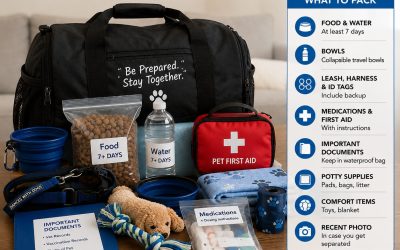
Real hurricane preparedness for dogs includes the physical kit, too. Two weeks of food and water, medications, vaccination records and county license, current ID tags and updated microchip registration, a photo of you with your dog in case you are separated, a leash and backup leash, waste bags, and comfort items like a familiar blanket and long-lasting chews. Store it with your family supplies so it evacuates when you do.
If you plan to use a pet-friendly shelter in Miami-Dade County, check the requirements now. Most require proof of vaccination and a crate, which brings us right back to skill one.
July Is the Gift. Use It.
Hurricane season officially runs June through November, but the Atlantic usually saves its worst for August, September, and October. That makes July the sweet spot: enough time to build real skills, calmly and positively, before the tropics wake up.
None of this training requires force, fear, or pressure. Every skill on this list is built with positive reinforcement, at your dog’s pace, in five-minute sessions that feel like games. That matters, because skills built through fear crumble under stress. Skills built through confidence hold.
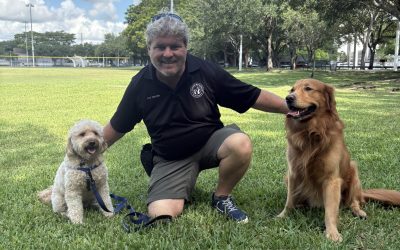
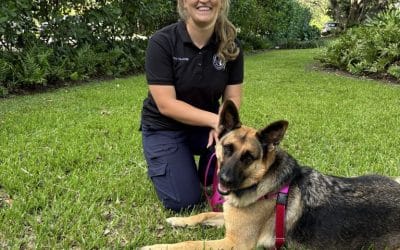
At Dances With Dogs, we’ve been helping Miami-Dade families with hurricane preparedness for dogs since 2002, from Pinecrest and Palmetto Bay to Coral Gables and Kendall. If you want a personalized storm-readiness plan, a Jumpstart Session gives you a working 90-minute consultation with a certified trainer who can assess your dog and get you started on the exact skills your family needs. If your schedule is packed, our board and train programs can build crate comfort, settle, and handling skills for you.
The storm will not wait for your dog to be ready. Start today, while the sky is blue, and September will feel a whole lot calmer for both of you.
Hurricane preparedness for dogs is not a September scramble. It is a July habit.
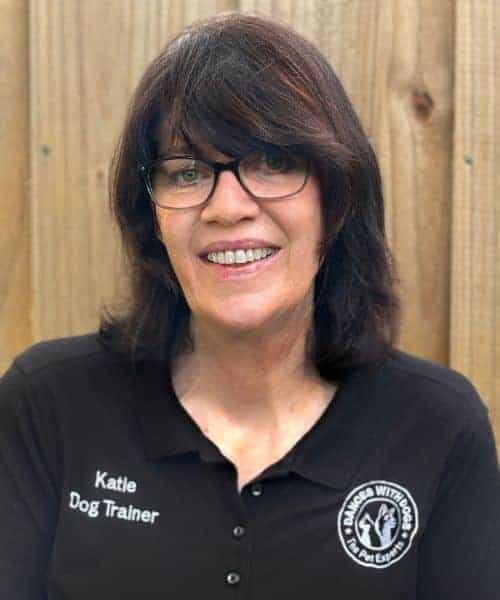
Katie Casell (KPA CTP, CPDT-KA, CSAT, FFCP, FDM, CPPS) is the founder of Dances With Dogs and a force-free trainer with over two decades of experience helping families build lasting bonds with their dogs. Her team of trainers, walkers, adventure specialists, and cat sitters is known for detail-oriented, reliable care that never uses fear or pain.