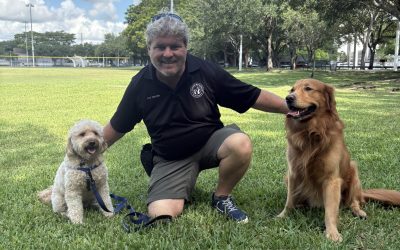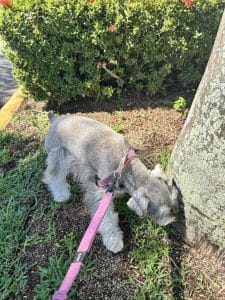
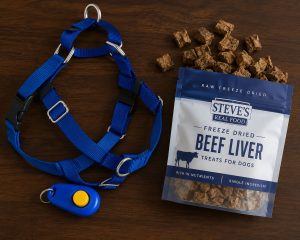
The actual force-free dog training tools we reach for: no shock, no prongs, no chokers.
Why the Bag Matters
Every dog trainer carries a bag. Inside, you’ll find the force-free dog training tools they reach for during a session, and those tools tell you more about their philosophy than almost anything else they could say. We get asked a lot of questions about methodology here at Dances With Dogs, but one of the most useful things we can do is simply show you what’s actually in our kit, what stays out of it, and why each choice matters for your dog’s learning and wellbeing.
This isn’t a takedown of any individual trainer. Plenty of well-meaning people grew up using tools that are now understood to carry real welfare costs, and the language in this industry has shifted faster than some training practices have kept pace. Our goal here is simply clarity, so you can recognize real force-free dog training tools (or their absence) the next time you’re shopping for gear or interviewing a trainer.
Force-Free Dog Training Tools We Use
Treat Pouch and Reinforcers
A treat pouch (sometimes called a bait bag) holds the reinforcers we use as force-free dog training tools, rewarding a dog in the moment a behavior happens. We call them reinforcers rather than treats because the goal isn’t a snack, it’s a tool that’s chosen and delivered with purpose to build a specific behavior.
- A bag that clips at the hip and opens easily matters for timing. Fumbling with a sandwich bag or your pocket slows you down, and timing is everything in reinforcement-based training.
- We vary what’s inside based on the dog and the task: everyday kibble for easy cues, higher-value options like freeze-dried liver for harder ones, or distracting environments.
- Reinforcers aren’t always food. A toy, a sniff break, or permission to greet a friendly dog can work just as well, depending on what motivates that individual dog.
Clicker
A clicker marks the exact moment your dog does something right, which sharpens communication and speeds up learning. It’s precise, it’s consistent, and it carries zero risk of discomfort.
- We use clickers extensively in foundational cue work.
- They’re especially valuable in behavior modification for fear and anxiety cases, where timing accuracy can make the difference between progress and setbacks.
Front-Clip Harness
A well-fitted front-clip harness gives you mechanical advantage on a walk without putting pressure on your dog’s throat or trachea.
- We’re careful about fit and technique, since a poorly adjusted harness can still cause chafing or restrict shoulder movement.
- Used correctly, it’s one of our go-to tools for dogs who pull.
Flat Collar (for ID, Not Leash Pressure)
We’re fans of flat collars for holding ID tags, but we typically don’t recommend clipping the leash directly to a flat collar for dogs who pull.
- Repeated pressure on the neck can affect the thyroid, trachea, and cervical spine over time.
- Collar use is a great example of how a tool isn’t inherently good or bad; it’s about how and where pressure is applied.
Long Line
A long line gives a dog more freedom to explore, sniff, and make choices in a safe, controlled way.
- We use these constantly during adventure walks, recall training, and decompression sessions.
- Freedom of movement and choice are core ingredients in building confidence, particularly for dogs working through fear-based behavior.
Mat or Station Target
A simple mat can become a powerful tool for teaching a dog to settle, especially in high-arousal environments like a vet waiting room.
- We pair this with relaxation protocols for dogs working through vet and handling fear.
- The goal is to build a strong, comfortable association with one specific spot.
Tools That Are Never Force-Free Dog Training Tools
Shock Collars (E-Collars)
Shock collars work by applying pain or discomfort to suppress a behavior. Even on the lowest “stimulation” setting marketed as a gentle tap, the mechanism is aversive by design, and suppression isn’t the same as teaching.
- A dog who stops barking because of a shock hasn’t learned a new skill; they’ve learned that barking is dangerous.
- This can create new fear and anxiety issues, sometimes worse than the original behavior.
- The American Veterinary Society of Animal Behavior has been clear in its position statements that punishment-based tools carry documented welfare risks and are not necessary for effective training.
Prong Collars
A prong collar works through pain distributed around the neck via metal links that pinch when pressure is applied.
- It’s marketed as a quick fix for pulling, but it teaches a dog to avoid pressure rather than what you’d actually like them to do instead.
- There’s no version of a prong collar that fits under a force-free definition, regardless of how gently it’s used.
Choke Chains
Choke chains tighten around the trachea under pressure.
- Unlike a properly fitted front-clip harness, there’s no way to use one without applying pressure to sensitive structures in the neck.
- We see these less often these days, but they still show up, especially in older training advice that’s been recycled online.
Slip Leads
Slip leads are everywhere right now, used by groomers, vets, shelters, and plenty of trainers, often just for convenience rather than as a deliberate training choice.
- A slip lead is a leash and collar in one, with no buckle, that tightens around the neck like a lasso when pressure is applied.
- Even without metal links or prongs, the mechanism still relies on neck pressure to control or correct, which puts it outside the scope of a force-free approach.
- We’ll use a slip lead briefly for safety in a true emergency, like a quick handoff at a vet’s office, but it’s not a tool we train with.
Citronella or Spray Collars
These are sometimes marketed as a gentler alternative to shock, but the mechanism is still aversive.
- It’s an unpleasant sensory experience designed to suppress a behavior through discomfort.
- The packaging is friendlier, but the underlying training is not.
Choke-and-Release “Leash Corrections”
This one is more about technique than equipment, but it’s common enough to mention.
- A sharp leash pop, sometimes called a correction, applies abrupt pressure to startle or interrupt a dog.
- It can work in the short term to stop a behavior, but it doesn’t teach the dog what to do instead.
- Repeated corrections are associated with increased fear, anxiety, and even aggression in multiple published studies.
A Quick Note on Martingale Collars
Martingale collars sit in a gray area, and we get asked about them often. Originally designed for dogs with narrow heads who can back out of a regular collar, a martingale tightens slightly when pulled but is not designed to choke.
- Used correctly, fitted properly, and paired with reward-based leash work, a martingale collar can have a place among real force-free dog training tools.
- Used as a substitute for actual leash skills, with constant tension and correction, it ceases to be force-free, regardless of the label on the box.
- As with most of the tools on this list, the question isn’t only what the tool is, but also how it’s used.
Three Questions to Ask Any Trainer
If you’re interviewing a trainer or evaluating a current one, these three questions will tell you almost everything you need to know:
- What happens if my dog gets a cue wrong? A force-free answer involves adjusting the difficulty, going back a step, or trying again. It should never involve a correction or punishment.
- Can you walk me through exactly how this tool is used? Watch for hesitation or vague answers about discomfort being “minimal” or “just a tap.”
- What’s your plan if this approach doesn’t work quickly? Force-free training is about consistency and management, while real learning happens, not reaching for a faster, harsher option when patience runs thin.
The Bottom Line
The equipment in a trainer’s bag isn’t just gear, it’s a window into their entire philosophy. At Dances With Dogs, every tool we carry is chosen because it teaches, supports, or builds confidence, never because it suppresses behavior through discomfort or fear.
If you’re evaluating a trainer for your own dog, ask to see what’s actually in the bag. The answer will tell you everything. Contact us today to learn more about the force-free dog training tools and approach we use throughout Miami-Dade.

Katie Casell (KPA CTP, CPDT-KA, CSAT, FFCP, FDM, CPPS) is the founder of Dances With Dogs and a force-free trainer with over two decades of experience helping families build lasting bonds with their dogs. Her team of trainers, walkers, adventure specialists, and cat sitters is known for detail-oriented, reliable care that never uses fear or pain.