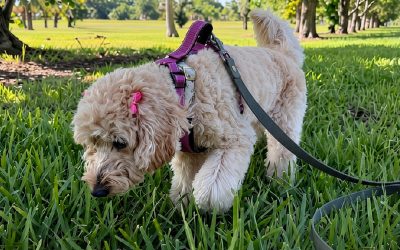
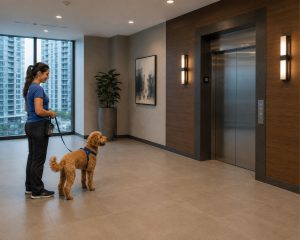
Elevator lobbies are exactly where apartment dogs need their training to hold up.
You have seen the ads. Send your dog away for two weeks, get back a “fully trained” dog. If you live in a Brickell high-rise or an Edgewater condo with a dog who drags you through the lobby, barks at the elevator, or melts down at the dog on the fourth floor, that pitch sounds like relief in a package.
Miami apartment dog training is a specific problem, and it deserves a specific answer. Before you hand over your dog and your deposit, it is worth understanding what each training format actually does, because the right choice depends on your dog, your goals, and where your dog actually lives. We offer both formats at Dances With Dogs, so this is not a sales pitch for one over the other. It is the conversation we have with nearly everyone who calls us, and it usually saves them thousands of dollars and months of frustration.
What Board & Train Actually Is (and Isn’t)
Board and train means your dog lives with a trainer for a set period, typically two to six weeks, and receives daily structured training sessions. Done well, it is a powerful format. Your dog gets consistent repetition from a skilled professional, distraction levels are controlled and increased deliberately, and new skills get installed faster than most busy owners can manage on their own.
Done poorly, it is something else entirely. Many programs in South Florida rely on e-collars and other aversive tools to produce fast, camera-ready results. The dog you get back may look obedient, but suppression is not the same as learning. Research consistently links aversive training methods to increased fear, stress, and an increased risk of aggression, which is exactly the wrong trade-off for a dog living in close quarters with hundreds of neighbors.
There is a second, quieter problem with board and train that has nothing to do with methods: the environment. A dog trained in a suburban house with a yard learns to behave beautifully in a suburban house with a yard. Your dog does not live there. Your dog lives with elevators, echoing parking garages, tile hallways, luggage carts, delivery runners, and a potty routine that involves a leash, a lobby, and a patch of grass shared with forty other dogs.
Why Apartment Life Changes the Math
Miami apartment dog training runs into one stubborn fact: dogs are notoriously poor at generalizing. A sit that is rock solid in a trainer’s kitchen often evaporates the first time the elevator doors open onto a stranger with a Great Dane. This is not stubbornness or a failed program. It is simply how canine learning works. Behavior is tied to context, and the context of a Miami apartment dog is unlike almost anywhere else a dog can live.
Consider what your dog actually needs to handle on a normal Tuesday:
- Passing other dogs at close range in hallways with no room to create distance
- Riding an elevator calmly next to strangers, strollers, and other pets
- Walking through a busy lobby without jumping on the front desk staff
- Toileting on schedule in a shared, high-traffic outdoor space
- Settling quietly at home while sounds travel through walls and floors
None of those skills can be fully trained anywhere except in and around your building. In-home training puts the learning exactly where the behavior needs to happen. Your trainer works with your dog in your hallway, your elevator, your lobby, and on your actual walking route, which means there is no generalization gap to close afterward.
The Price Question, Answered Honestly
Board and train carries a premium price because you are paying for a professional’s time every single day, plus housing and care. Programs around Miami commonly start near $2,900 for two weeks, and comprehensive programs run well beyond that. Our own board and train packages begin at $3,500 for two weeks, and we are upfront that the format is a significant investment.
In-home private training spreads the cost differently. Instead of paying for round-the-clock immersion, you pay for focused sessions where a certified trainer teaches both your dog and you, then coaches you through the practice that happens between visits. For most Miami apartment dog training goals, like manners, leash skills, and everyday life skills, a package of private sessions costs a fraction of a residential program and produces results that hold up in the environment where your dog actually lives.
There is also a hidden cost calculation most people miss. When a board and train dog comes home and the skills do not transfer, owners often end up purchasing private sessions anyway to bridge the gap. Starting with in-home training skips that expensive detour for many families.
Where Board & Train Genuinely Shines
None of this means board and train has no place in Miami apartment dog training. In the right situation, it is the best tool available. We built our program around the cases where the format truly earns its price:
Foundation skills for puppies and adolescents. Young dogs benefit enormously from a concentrated period of consistent structure, especially when their families are stretched thin. Two focused weeks can install house manners, crate comfort, recall foundations, and leash skills that would take months of inconsistent home practice.
Life transitions. A move, a new baby, a work crunch, or travel can make it nearly impossible to train consistently at home. A well-run residential program keeps progress moving during a chaotic season.
Owners who want a professional head start. Some people learn best by watching a finished behavior and then maintaining it with coaching. Our programs include structured transfer sessions precisely because the handoff is where most board and train programs fail.
Our board and train runs from a trainer’s private home with a strict cap of three dogs at a time, which means individualized attention rather than kennel-style volume. We are also clear about what we will not take into the program: aggression, separation anxiety, and severe reactivity cases belong in private behavior work with the owner present, not in a board and train setting. Any program that promises to fix those issues in two weeks away from you deserves serious skepticism.
Where In-Home Wins for Miami Apartment Dog Training
For the majority of condo and apartment dogs we meet, in-home training is the better first move, for reasons that go beyond price:
The training happens in the real environment. Miami apartment dog training works best when elevator manners get taught in your actual elevator and hallway passing gets practiced in your hallway. There is nothing to transfer because nothing was learned somewhere else.
You learn alongside your dog. Training is a relationship skill, not a product you purchase. When you understand how your dog learns, you can handle new situations for the rest of their life, whether that is a new neighbor’s dog or a construction project on your floor.
The bond stays intact. Your dog never wonders where you went. For sensitive dogs especially, learning with their person present builds confidence instead of spending it.
Progress is visible from session one. You watch every step, ask questions in the moment, and never have to take anyone’s word for what happened while you were not there.
Force-free methods, always. Every technique we use is one you can see, understand, and feel good about. No shock, no prong, no intimidation, in the session or behind closed doors.
How to Choose: A Simple Framework
Every Miami apartment dog training decision comes down to three questions.
First, what is the actual problem? Manners and foundation skills can succeed in either format. Fear, reactivity, aggression, and separation anxiety need private, in-home behavior work with a qualified professional, full stop.
Second, where does the behavior need to happen? If the answer is “in and around my building,” in-home training targets that directly.
Third, what does your season of life allow? If you genuinely cannot practice between sessions right now, an ethical board and train with a strong transfer plan may serve you better than private sessions you cannot support.
The Bottom Line for Miami Apartment Dogs
A low sticker price on a two-week send-away program is only a bargain if the results survive the elevator ride home. For most Miami apartment dog training goals, in-home delivers skills where they are needed. When board and train is the right call, choose a program that is transparent about methods, limits its intake, and invests heavily in teaching you before your dog comes home.
Not sure which path fits your dog? We are happy to talk it through honestly, even if the answer is not the more expensive option. That is what 20+ years of force-free training in Miami-Dade has taught us: the right fit beats the fast sell, every time.
FAQ
A few questions come up in almost every Miami apartment dog training consultation.
Q: Is board and train worth it for an apartment dog? A: It can be for foundation and manners work, but skills learned in a trainer’s home often need extra transfer work to hold up in condo environments. Effective Miami apartment dog training happens directly in your building, which is why in-home sessions tend to hold up better.”
Q: How much does dog training cost in Miami? A: Board and train programs in Miami typically start around $2,900 to $3,500 for two weeks. In-home private training packages cost significantly less and include owner coaching.
Q: Can board and train fix aggression or separation anxiety? A: No responsible program should claim this. Aggression, severe reactivity, and separation anxiety require private behavior work with the owner involved, and separation anxiety in particular must be addressed in the home where it occurs.
Q: What is force-free dog training? A: Force-free training uses reward-based methods grounded in learning science, with no shock collars, prong collars, or intimidation. It is the approach recommended by leading veterinary behavior organizations.

Katie Casell (KPA CTP, CPDT-KA, CSAT, FFCP, FDM, CPPS) is the founder of Dances With Dogs and a force-free trainer with over two decades of experience helping families build lasting bonds with their dogs. Her team of trainers, walkers, adventure specialists, and cat sitters is known for detail-oriented, reliable care that never uses fear or pain.