
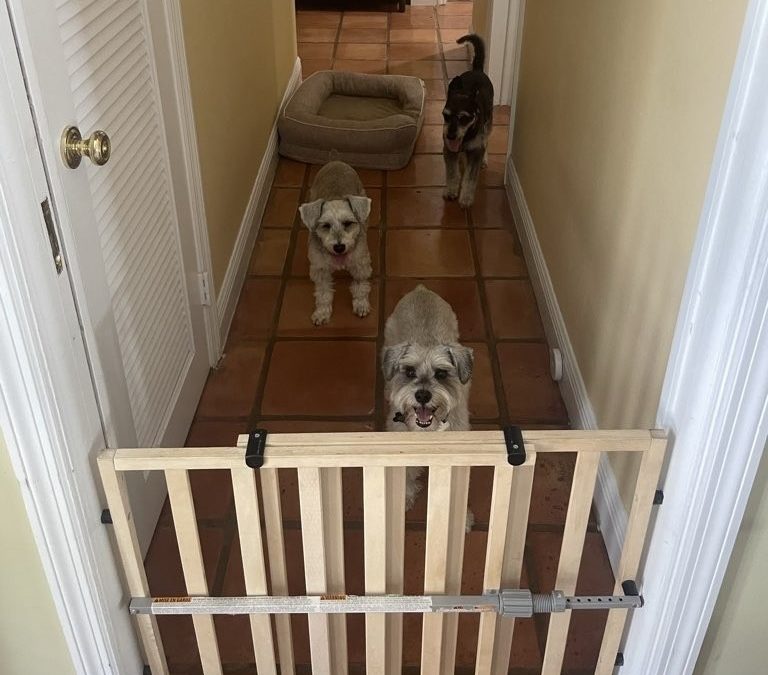
A gate in a hallway gives your dog distance from the front door without shutting him away from the household.
By Katie Casell, KPA CTP, CPDT-KA, FFCP, FDM, CSAT, CPPS. Owner and lead trainer, Dances With Dogs, serving Miami-Dade County since 2002.
Fear of strangers in the home is one of the most common calls we get.
The dog has been part of the family for years. They love him. He is sweet, he is easy, and he has never done anything like this before. But they had never had that many people in the house at once, and everyone wanted to say hello to him. How do you tell people no, you can’t say hello to my dog?
Someone reached down to pet him, and he snapped.
To the family, it came out of nowhere. It almost never does. A snap or a bite is usually the last thing a dog says, not the first.
He had been telling everyone in the room the whole time. He got stiff. He turned his head away. You could see the whites of his eyes. He was yawning, and he wasn’t tired, and licking his lips and he hadn’t just eaten. People kept putting their hands in his face to offer him treats, and that put him in conflict, because he wanted the piece of chicken, but the hand coming at his face was scaring him at the same time. He tried to leave. He backed away when someone reached over his head to pet him. And when none of that worked and there was nowhere left to go, he snapped.
It’s also one of the most manageable problems we see, because almost none of the fix depends on your dog getting braver. It depends on the people in the house handling the situation differently.
The short version: A guest protocol works when it removes the dog’s need to make decisions. Set up a safe space before anyone arrives, keep your dog behind a barrier during the door greeting, ask guests to ignore the dog completely, and let the dog decide whether to approach. Never force contact, and never scold him for growling.
“He’s fine once he warms up”
That sentence comes up in nearly every consult, and sometimes it’s true. Often it’s not. What looks like warming up is frequently a dog who stopped protesting because protesting didn’t work. The barking fades, the dog is quiet, everyone relaxes, and the silence is read as acceptance. Then the guest stands up to leave, leans down to say goodbye to the nice dog who finally settled, and gets bitten.
A guest protocol fixes this not by making your dog love strangers, but by taking the decision out of your dog’s hands. That is the whole idea. A frightened dog left to negotiate a houseful of unfamiliar people may make choices you don’t want. A frightened dog with a plan, a barrier, and a predictable routine does not have to negotiate anything.
Why the home is harder than the sidewalk
Owners are often confused that their dog greets people fine at the park but comes apart in the living room. There are real reasons for that.
Space is finite. Outdoors, a worried dog can arc, move away, sniff the ground, and create distance. Inside a Miami condo or a house with a narrow hallway, there is nowhere to go. The dog’s ability to increase distance, which is the primary way dogs manage fear, is gone.
The guest also does not behave like a stranger on a sidewalk. Visitors come through the door talking loudly, moving toward the dog, leaning over, and reaching out. Every one of those things is socially rude in dog language.
Finally, the doorbell has been rehearsed hundreds of times before you ever invite anyone over. Think about who actually rings it. Package deliveries, food deliveries, someone leaving a flyer on the door. In almost every one of those cases, the dog barks and the person goes away. Your dog does not know they were leaving anyway. From where he is standing, barking is the thing that made them leave, and it has worked over and over again. By the time real guests show up, that response has been practiced more times than you could count, and it has rarely failed him.
What fear of guests actually looks like
Barking and lunging are easy to spot. The quieter signals are the ones that matter more, because they show up earlier and they’re the ones people miss.
Watch for a dog who retreats to another room and stays there. A dog who takes a treat and then spits it out. A dog who goes still, holds a hard stare, and stops blinking. Whale eye, where you see the whites at the corners. Tongue flicks, yawning, scratching, or shaking off when they’re not wet. Pacing between the guest and the door. A dog who jumps frantically at his owner for attention, or jumps on the guest and then immediately leaves.
That last one causes the most trouble. Conflicted dogs approach and retreat in the same breath. Approach is not consent, and it’s not an invitation to reach for the dog.
Growling deserves its own sentence. A growl is information, and it’s the single most useful thing a fearful dog can give you. When a dog gets scolded or told no for growling, he does not stop being afraid. He learns that growling gets him in trouble, so he skips it. Now you have a dog who goes from quiet to biting with nothing in between.
Before the guests arrive
Most of the work happens before anyone knocks.
Decide where your dog is going to be. There are two setups, and the one you pick depends on your dog.
The first is full separation, meaning a closed door between your dog and the visitors. This is for the dog who cannot cope with seeing strangers in his house, and for any dog who has snapped or bitten. He does not need to watch. Watching is the hard part for him.
The second is a barrier in the shared space, meaning a tall pressure-mounted gate or an exercise pen. This is for the dog who is worried but manages, who can eat and settle with people in view. He gets distance and a barrier he can trust without being shut away from his family. Two gates in a doorway, spaced a few feet apart, are better than one for a dog who jumps or bulldozes.
You can also combine them. Gate the doorway of the safe room instead of closing the door. Your dog gets the quiet room and the physical barrier, but not the confinement, which matters a great deal if closed doors are hard for him.
Build the safe space before you need it. Pick an interior room with a door, ideally the one furthest from the entry. Put a bed, water, and something the dog already loves in there. Run a fan or white noise to blunt the sound of arrivals. Your dog needs to like this room before you ever ask him to use it on a hard day, so start by feeding his meals in there and giving him chews with the door open and no visitors in the house.
Once he is going in on his own, practice the door. Give him something good, close the door for a few seconds, and open it before he asks you to. Build from there. A minute, then five, then the length of a chew. If he settles and falls asleep in there with the door shut and nothing happening, he is ready. If he scratches, whines, or panics, don’t use a closed door on guest day. Cover a gate instead, and know that being closed in is its own separate problem worth working on.
If the only time he ends up in that room is when strangers are over, it becomes the room where bad things happen instead of the room where he feels safe.
Exercise and sniff beforehand. A sixty to ninety minute decompression walk earlier that day changes what your dog has left in the tank. This is not about tiring him out. Sniffing lowers arousal and gives the nervous system a chance to reset before you ask it to cope with something hard.
Prep the guests by text, not at the door. No one follows instructions well while standing in a doorway with a barking dog in front of them. Send it in advance. Something like: “Quick heads up, our dog is nervous with new people. Please text when you’re outside instead of ringing the bell; come straight in, and completely ignore him. No eye contact, no talking to him, no reaching for him, even if he comes over. He may come say hi on his own, and that’s fine. Thank you.”
Kill the doorbell. Tape over it, disconnect it, or put up a sign. Removing the trigger entirely is not cheating; it’s the fastest single change most households can make.
The first ninety seconds
The arrival is the hardest part of the entire visit, and it’s the part people improvise. Don’t improvise it.
Before your guests are at the door, your dog goes into the safe room or behind the gate with a long-lasting chew or a stuffed frozen food toy. That happens early, not while someone is knocking. The chew should arrive before he is upset, not as a response to being upset.
Let your guests come in, get settled, sit down, and stay seated. Your dog is not part of the greeting. If you can hear steady chewing and see loose body language, you are doing well.
If your dog is barking at the gate and not settling, block his view. Drape a blanket over it or clip a panel to the front so he cannot see into the room. If he is in the safe room and closed doors are easy for him, closing it works too. Either way, you have lost nothing. Getting him further from the visitors is not a failure; it’s the plan working.
Whether your dog comes out at all
This is the decision most owners get wrong, because the goal quietly becomes “the dog joins the party” instead of “the dog is safe and comfortable.”
Use three criteria. Can your dog eat normally, taking food gently and swallowing it? Can your dog settle, meaning lying down and staying down for more than a few seconds without popping back up? Can your dog disengage, meaning look at the guest and then look away on his own?
If all three are true, you can bring the dog out on a leash or open the gate, with the guest still seated and still ignoring him. If any one of them is false, the dog stays where he is. That is a successful visit. A dog who spent two hours calmly chewing in a back bedroom while people laughed in the living room just had a good experience with guests, and that experience is what changes the pattern over time.
The four rules for guests
- No eye contact.
- No reaching, petting, or leaning over.
- No talking to the dog, no kissy noises, no calling him over.
- Let the dog choose, and let him leave.
If your guest wants to help, they can toss a treat sideways or slightly behind the dog, away from themselves, without looking at him. That is the key detail. Treats tossed toward the guest lure a worried dog into a space he is not ready to enter, and he arrives closer than he intended, at which point he panics. Tossing away from the body builds a positive association without setting a trap.
The single hardest guest to manage is the one who insists dogs love them. Be direct with that person in advance, because they will not read the room in the moment.
What to avoid entirely
Don’t have guests hand-feed a fearful dog. Don’t force greetings, hold the dog for petting, or hand the leash to a stranger. Don’t flood the dog by having ten people over “so he gets used to it.” Don’t use leash corrections, spray bottles, or noise devices at the door, because pairing something aversive with the presence of strangers builds the exact association you are trying to undo. And don’t let anyone tell you to let the dog and the guest work it out.
When fear of strangers in the home needs professional help
If your dog has bitten, air-snapped, or made contact with any person, stop working on this alone. Start with your veterinarian. Fear that severe often has a medical or pharmacological component, and pain in particular is an underrecognized driver of aggression toward visitors. Your vet can rule out medical contributors and, if appropriate, refer you to a veterinary behaviorist. Diagnosis and medication are their scope, not a trainer’s.
A qualified force-free trainer then builds the behavior plan around that: systematic desensitization and counterconditioning to arrivals, a stationing or place behavior that has real value, and a graduated visitor plan using helpers who follow the rules exactly.
Don’t wait for it to resolve on its own. Fear of strangers in the home reliably gets worse with rehearsal, and every uncontrolled visit is another rep.
Your dog does not have to love your guests. He has to be safe, and he has to be able to opt out. Build the protocol around that, and the rest follows.
Common Questions About Dogs and Guests
Should my dog greet guests at the door?
No. The doorway is the most crowded, highest arousal moment of any visit. Have your dog behind a gate or in a separate room with something to chew before the guest arrives, and let people get seated first.
Is it okay to have guests give my dog treats?
Only if the treat is tossed away from the guest, sideways or slightly behind the dog, with no eye contact. Hand-feeding pulls a frightened dog closer than he is ready to be, which often ends in a snap.
Should I scold my dog for growling at visitors?
No. A growl is a warning, and suppressing it produces a dog who bites without warning. Treat a growl as useful information and increase distance.
How long does it take to fix fear of strangers?
It varies widely. Management works immediately, meaning your dog can be safe and comfortable from the first visit. Changing the underlying emotional response through desensitization and counterconditioning usually takes months of consistent, well-planned sessions.
My dog has snapped at a guest. What now?
Stop all uncontrolled guest visits and start with your veterinarian, who can rule out pain or medical contributors and refer to a veterinary behaviorist if needed. Then work with a qualified force-free trainer on a structured plan.
Does my dog have to socialize with my guests?
No. A dog who spends the visit calmly chewing in a back room is having a successful, positive experience with guests. Comfort and safety are the goal, not participation.
Katie Casell is the owner and lead trainer of Dances With Dogs, a force-free, science-based training company serving Miami-Dade County since 2002. She is a KPA CTP, CPDT-KA, FFCP, FDM, and CSAT, and specializes in fear, anxiety, and separation anxiety cases.

Katie Casell (KPA CTP, CPDT-KA, CSAT, FFCP, FDM, CPPS) is the founder of Dances With Dogs and a force-free trainer with over two decades of experience helping families build lasting bonds with their dogs. Her team of trainers, walkers, adventure specialists, and cat sitters is known for detail-oriented, reliable care that never uses fear or pain.