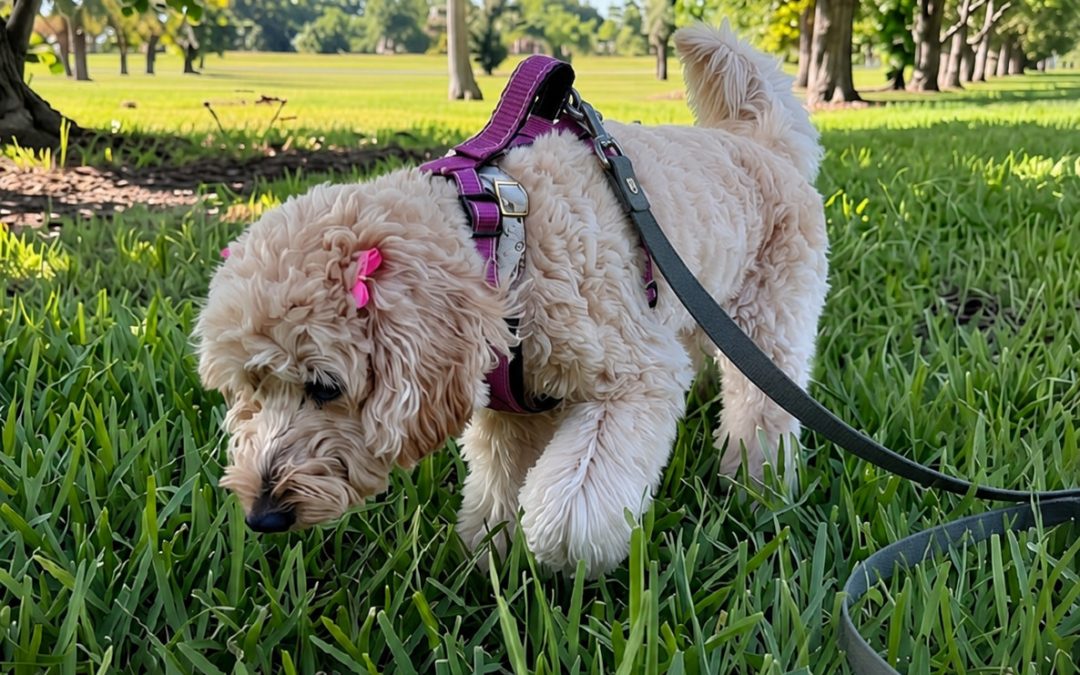
No heeling, no hurry, no destination. This is the entire technique.
Your dog gets walked every day. You clip on the leash and head down the sidewalk or street. You cover the same route every day, and 15 to 30 minutes later, you’re back home. Your dog is tired. And yet, the barking at the window has not gotten better; the restless pacing in the evening is still the same, and your dog still pulls on the leash just as much as they did six months ago.
Physical exercise isn’t the same as mental recovery. That gap is why decompression walks for dogs have become one of the most talked-about tools in modern, science-based training, and why we build them into so many of the behavior plans we write here in Miami-Dade.
What is a Decompression Walk?
A decompression walk is a long, unhurried outing in a natural or low-traffic environment where your dog is given a long line and permission to make most of the choices. Where to go. What ot sniff. How long to linger. Whether to move fast or stand still for four minutes investigating one patch of grass or a single leaf.
There is no heeling, No Sit-stays. No correction for a leash that is loose. You are not training during a decompression walk. You are giving the dog the canine equivalent of a quiet weekend with no notifications.
The core ingredients are simple:
- A long line, typically 15 to 30 feet
- A well-fitted harness, never a collar, and never a retractable leash
- A quiet location with room to explore
- Sixty to ninety minutes of unrushed time
- A handler who follows rather than leads
The last one is the hardest for most of us, and it’s the one that matters most.
Why Decompression Walks for Dogs Matter More Than Owners Realize
Dogs experience stress that accumulates. A startling noise, a tense encounter with the barking dog across the street, a busy household, a schedule change, a vet visit. Each event raises arousal, and its physiological effects don’t vanish the moment it ends. When stressful events stack faster than a dog can recover from them, you get what behavior professionals call trigger stacking, and the visible result is a dog who seems to overreact to even the smallest thing.
Sniffing is one of the most efficient recovery tools a dog has. A dog’s olfactory system is extraordinary, and using it is genuinely demanding work. Scent processing engages a huge portion of the canine brain, and sustained sniffing has been associated with a lower heart rate and a shift toward a calmer physiological state.
There is also research suggesting that scent work changes how a dog interprets ambiguous situations. In a well-known 2019 study, dogs enrolled in nosework activities showed more optimistic responses on a cognitive bias test than dogs doing heel-focused training. In plain language, dogs who got to use their noses seemed to expect better outcomes from the world. That is not a small finding for anyone living with a fearful, reactive, or anxious dog.
Add to that the fact that most adult dogs need somewhere in the range of twelve to sixteen hours of sleep and rest per day, and a picture emerges. Many of the dogs we meet are not under-exercised. They are under-rested and over-aroused.
Decompression Walk vs Regular Walk
A standard neighborhood walk is a transportation event. You have a destination, a pace, and a time limit. Your dog is managing sidewalk traffic, passing dogs behind fences, delivery trucks, and the constant low-grade pressure of a six-foot leash that stops them every time they want to investigate something.
A decompression walk removes the pressure. The leash is long enough that it rarely becomes tight. The environment is chosen for quiet rather than convenience. Your dog sets the agenda.
Both types of walks have value. But if every single outing is the first kind, you are meeting their physical needs while leaving their behavioral needs unaddressed.
Signs Your Dog Needs Decompression Walks
Consider adding decompression walks if your dog:
- Struggles to settle in the evening even after exercise
- Reacts strongly to dogs, people, or noises outside the home
- Seems to have a shorter fuse than they did a few months ago
- Has recently been through a move, a new baby, a boarding stay, or a schedule change
- Is an adolescent between roughly six and eighteen months
- Is recovering from an illness, injury, or stressful medical event
- Is newly adopted and still learning the household
Newly adopted dogs in particular benefit enormously. Decompression walks build trust without demanding anything from a dog who is still deciding whether this new life is safe.
How to Do Decompression Walks in Miami
Our climate changes things. Here’s how we adapt.
Time it around the heat. From about May through October, the only reliable safe windows are early morning and late evening. We start many of our warm-season outings before seven in the morning. Press the back of your hand to the pavement for seven seconds. If you cannot hold it there comfortably, your dog should not be walking on it.
Know where you are actually allowed to go. This trips up many Miami dog owners, and the answer is more specific than most people expect. Miami-Dade County Code prohibits bringing a dog into any county park unless that particular area has been designated for dogs. Our Pine Rockland and Hammock preserves are closed to dogs entirely, and that is not bureaucracy for its own sake. Those are among the rarest habitats left in North America, and dogs disturb the ground-nesting wildlife in them
The good news is that the county publishes an actual list, so you are not guessing. Fifteen county parks permit leashed dogs. In the southern half of the county, those are Chapman Field Park, Snapper Creek Park, Rockdale Park, Deerwood Bonita Lakes Park, Kings Meadow Park, Olympic Park, West Kendale Lakes Park, Coral Villas Park, and Kevin Broils Park. Chapman Field is by far the largest park at roughly 483 acres, and Snapper Creek Park is open around the clock, which matters enormously if you are trying to walk before the heat arrives. Check the county parks website for the current list and posted rules before you go, and note that hours vary a lot from park to park.
Two things to watch. Florida state parks welcome leashed dogs, but the statewide rule requires a handheld leash six feet or shorter, so places like The Barnacle in the Grove are lovely walks and not long-line locations. Municipal parks run by individual cities operate under their own ordinances, so a quick call to the city parks department is worthwhile.
If you want a genuinely quiet hour with no other dogs in the picture, private land is the reliable answer. Renting an acre ot two through a platform like Sniffspot, or arranging access directly with the property owner, gives you exclusive use of the space. That is what we use for our own clients, and it is the only option that consistently delivers what a decompression walk actually requires.
Choose shade and surfaces carefully. Grass, mulch, packed dirt, and shaded areas are far kinder than asphalt and concrete. Shade is not optional here from May to October.
Bring more water than you think you need. For both of you. Bring collapsible bowls and take a break in the shade every fifteen or twenty minutes during the warm months.
Plan for local wildlife. Iguanas, Muscovy ducks, raccoons, opossums, and the occasional snake all live here. A long line gives freedom, but it also means you need to stay alert and keep your dog out of dense brush where you cannot see what is in there. I have seen dogs come out of bushes with ducks and iguanas. Keep parasite prevention current year-round; we don’t get a break here in South Florida. Our mosquito, flea, and tick seasons never end.
Watch the water, all of it. Most people know to worry about alligators in canals, lakes, and retention ponds. Fewer realize that brackish and salt water is not safe here; it is a different animal. South Florida is the only place in the country with a wild American crocodile population, and Biscayne Bay is a documented habitat with confirmed nesting. Crocodiles prefer mangrove-lined coves, creeks, and protected canals, and they move inland through our canal system. Both species overlap in brackish zones, so a mangrove shoreline can hold either one.
This matters for specific places you might take your dog. Chapman Field sits on Biscayne Bay, and the path toward the dog park runs alongside brackish, mangrove-lined water. The road to the dog park and the open area next to it is now paved, so you can always drive. Coral Gables waterways are in the same category. In 2022, an eight-foot crocodile was captured walking a residential street in Gables by the Sea, with Coral Gables and Pinecrest police escorting it.
The practical rule is simple. Keep your dog out and away from the edge of any natural water, fresh, brackish, or salt. A twenty-foot-long line means your dog can reach a shoreline before you can react, so choose your route accordingly and shorten up near water. Blue-green algae blooms are another real reason to stay out.
Use the right equipment. A well-fitted Y-front harness and a twenty-foot Biothane long line. We settled on twenty after running these in Miami. You can always shorten up and handle it at fifteen, but you can never make a fifteen-foot line longer, and the extra five feet nearly doubles the ground your dog can actually reach. Biothane wins in our humidity because it does not absorb water or hold odor. Gloves are worth it for everyone handling a strong dog on a long line.
Common Mistakes to Avoid
Talking too much. Constant chatter and cheerful encouragement interrupt the dog’s focus. Let there be quiet.
Rushing the sniffing. If your dog has been on one bush for three minutes, the walk is working. Be patient. Wait.
Using a retractable leash. Three separate problems. First, the mechanics: a retractable cannot be shortened while your dog is pulling, because the spring can only rewind when the dog’s pulling force drops below it. Manufacturers acknowledge this in their own patent filings. When you need to bring your dog closer most, the tool will not let you. Second, the thin cord causes real injuries, including lacerations, rope burns, and finger fractures, and locking mechanisms fail. Emergency department data show leash-related injuries rising sharply over the past two decades, most often from a dog pulling.
Choosing a location that is too busy. A space with other dogs in it is not decompression. It is another arousal event with better scenery. If you cannot get the place to yourself, you are doing something else, not a decompression walk.
Turning it into a training session. The moment you start asking for behaviors, the walk stops being decompression. Save the training for a different outing.
Attaching a long line to a flat collar. A dog who hits the end of a twenty-foot long line at speed can be seriously injured. Harness only.
How Often Should You Do Them?
For most dogs, two or three decompression walks per week create a noticeable difference within a month. For dogs working through fear, anxiety, or reactivity, we often recommend more, and in some cases we temporarily reduce or eliminate stressful neighborhood walks entirely while a dog recovers.
You will usually see changes in sleep quality first, then in the intensity of reactions, then in general resilience.
Guided Decompression Walks with Dances With Dogs
Not everyone has the time, the equipment, or the comfort level to handle a long line in an unfamiliar location. This is where our team comes in.
Most of our decompression walks are run by Dances With Dogs team members who have been specifically trained for this work. That training is not incidental. Handling a twenty-foot line safely, recognizing the difference between a dog who is settling and a dog who is shutting down, knowing when to wait out a long sniff and when to move on, reading heat stress before it becomes a problem: none of that is intuitive, and all of it is teachable. Our specialists learn it before they ever take a client dog out alone. These outings are available in Pinecrest, Palmetto Bay, South Miami, Cutler Bay, Kendall, and Coral Gables.
For dogs working through fear, anxiety, or reactivity, and for clients already in an active behavior or training plan with us, a credentialed trainer runs the outing instead. The difference is not the walk itself, it is the depth of body language reading and the ability to adjust the session in real time as part of a larger plan. Trainer-led outings are available throughout Miami-Dade County.
Not sure which one fits your dog? Call us and we will tell you honestly. Sometimes the answer is that a training session should come first.
Every outing is one-on-one. We never group dogs together, because a decompression walk with a strange dog attached to it is not a decompression walk.
Dances With Dogs has served Miami-Dade families since 2002 using force-free, science-based methods on every single outing.
Call or text 786-833-8763, or visit danceswithdogs.com for more information.

Katie Casell (KPA CTP, CPDT-KA, CSAT, FFCP, FDM, CPPS) is the founder of Dances With Dogs and a force-free trainer with over two decades of experience helping families build lasting bonds with their dogs. Her team of trainers, walkers, adventure specialists, and cat sitters is known for detail-oriented, reliable care that never uses fear or pain.