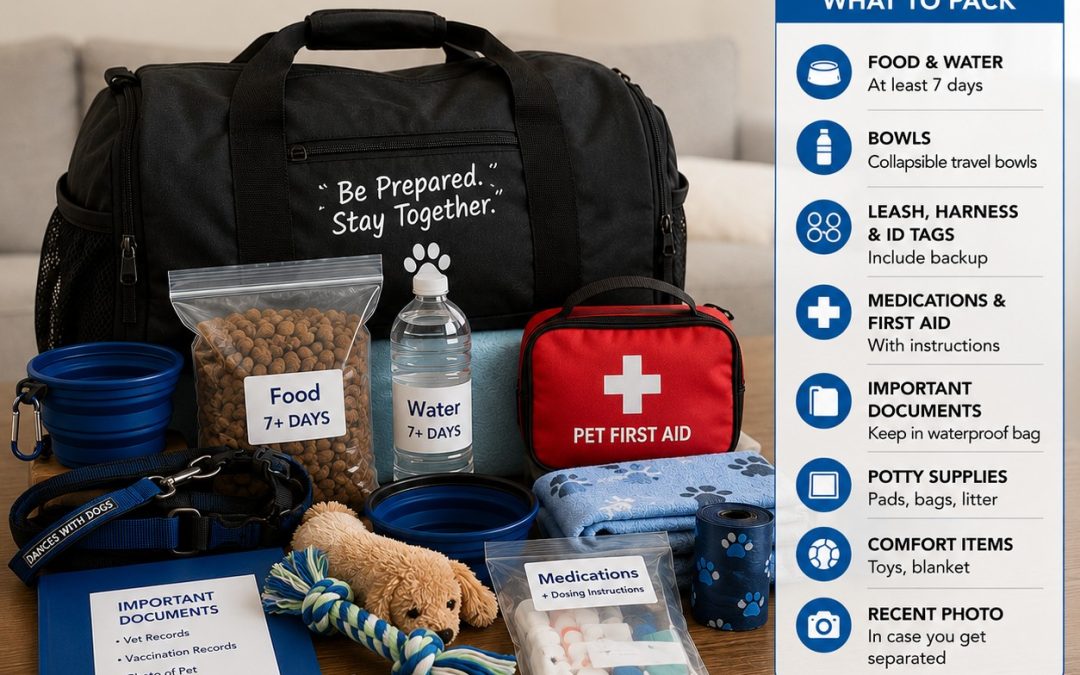
Everything your dog’s hurricane go-bag needs, packed and ready before the first storm forms. Plan ahead, pack today.
If you have lived in Miami through even one storm season, you know the drill for your house. The question is whether you have an equally solid drill for your dog.
This is the complete 2026 guide to hurricane prep for Miami dog owners: what goes in the go-bag, where your dog can actually stay if you evacuate, and how to keep a stressed dog functioning when the routine falls apart. Print it, work through it this week, and you will spend the next storm watching radar instead of scrambling.
We covered the training side in depth in our companion post on hurricane preparedness for dogs, which walks through the five skills to build before a storm arrives. This checklist covers everything else.
The Dog Go-Bag: Pack It Now, Not at the Watch
The go-bag is step one of hurricane prep for Miami dog owners.
Your dog needs a dedicated, packed, grab-and-go kit stored with your family supplies. Not a mental list. A physical bag. When an evacuation order comes for coastal Miami-Dade, you will not have the bandwidth to gather fourteen items from six rooms.
Food and water. Two weeks of your dog’s regular food in an airtight container, plus a manual can opener if any of it is canned. Rotate it every few months so it stays fresh. Pack at least a gallon of water per day for a medium dog, and collapsible bowls. Rotating supplies quarterly keeps this piece of hurricane prep for Miami dog owners fresh year round.
Medications and health records. Two weeks of any medications, stored with the pharmacy label. Printed copies of vaccination records, your county license, and your vet’s contact information. Add a copy of your dog’s rabies certificate, specifically, since pet-friendly shelters require proof. The AVMA’s pet disaster preparedness checklist is a good printable companion to this list.
Identification. Current ID tags on a well-fitted collar, and confirm your microchip registration lists your current phone number today. After a storm, a microchip with an old number is nearly useless. Pack a printed photo of you with your dog, which proves ownership if you are separated.
Restraint and containment. A leash plus a backup, a harness, and a crate. If shelter space is a possibility, the crate is not optional, and your dog needs to be comfortable in it long before September. Our crate training guidance covers how to build that comfort force free.
Sanitation. Waste bags, puppy pads, paper towels, and a small bottle of enzymatic cleaner. If your dog may need to potty indoors or on a balcony during the storm, pads plus a patch of sod make that far more likely to succeed.
Comfort and enrichment. A familiar blanket that smells like home, two or three long-lasting chews, a stuffable toy, and a few days of high-value treats. Enrichment is not a luxury during a hurricane. A dog with something to chew is a dog with an outlet for stress.
Where Your Dog Can Go: Shelters and Hotels in 2026
Hurricane prep for Miami dog owners has one rule above all others: never plan to leave your dog behind. Dogs left in evacuated homes face life-threatening conditions, and Florida law can treat abandonment during a disaster as animal cruelty. Every evacuation plan needs a dog-inclusive destination, and ideally two.
Pet-friendly evacuation centers. Miami-Dade County operates designated pet-friendly evacuation centers, but they come with conditions. Registration is typically required in advance, dogs must be crated, and you must bring proof of current rabies vaccination plus your own supplies. Check the county’s evacuation center page at the start of each season, because locations and requirements can change year to year. Do this now, not when a storm is named.
Pet-friendly hotels. If you evacuate inland or out of the region, call hotels before you drive. Many chains that advertise as pet friendly cap the number of pets per room, charge fees, or suspend pet policies during emergencies when demand spikes. Keep a short list in your phone of two or three pet-friendly options along your evacuation route, with direct phone numbers. Book early, since pet-friendly rooms are the first to sell out when a cone shifts. Hotel research is the part of hurricane prep for Miami dog owners most people skip until it is too late.
Friends and family. Often the best option of all. Line up a standing agreement with someone inland, in Broward, Orlando, or wherever your family tends to head, and confirm their comfort with your dog now. If their household includes other pets, arrange a meet-up in calm weather first, not in the middle of a mass evacuation. Building that network is the cheapest piece of hurricane prep for Miami dog owners and often the most valuable.
Boarding as a backup. Some boarding facilities and veterinary hospitals outside evacuation zones accept storm boarders, but they fill fast, and most require current vaccinations on file. If this is your plan, get your dog’s records to the facility in advance. Advance paperwork turns boarding from a scramble into a real option for hurricane prep for Miami dog owners.
Keeping the Routine When the Routine Is Gone
Routine management is the forgotten half of hurricane prep for Miami dog owners. Dogs are pattern animals. Meals, walks, and sleep at predictable times tell your dog the world is working correctly. A hurricane deletes all of it, and for many dogs the disrupted routine is as stressful as the noise.
You cannot keep the whole routine, but you can protect the anchors:
Feed on schedule. Even if everything else is chaos, feed at the normal times. Meals are the strongest daily anchor most dogs have. If your dog is too stressed to eat, do not force it, but offer again at the next normal time.
Substitute the walk. When outdoor exercise is impossible, replace it with indoor work at the usual walk time. Scatter feeding, scent games, food puzzles, and short training sessions burn mental energy, and ten minutes of sniffing for kibble in towels tires most dogs more than people expect.
Protect sleep. Keep your dog’s bed or crate in a consistent interior spot away from windows, and let your dog retreat there without interruption. If children are in the home, make the dog’s rest area off limits during the storm.
Manage your own energy. Dogs read us constantly. You do not need to fake calm perfectly, but keep interactions with your dog low-key and predictable. Slow movements, a normal voice, and unhurried handling all signal that the situation is manageable.
Storm Anxiety: What Helps and What Does Not
No plan for hurricane prep for Miami dog owners is complete without an anxiety strategy. Some dogs sail through hurricanes. Others tremble, pace, drool, hide, or refuse food. If your dog struggles, a few evidence-based points matter.
Comforting your dog does not reinforce fear. That old myth needs to retire. Fear is an emotion, not a behavior you can reward into happening more. If your dog seeks you out during the storm, calm contact and a steady presence help.
White noise, a fan, or a television can partially mask wind and rain, and an interior room reduces both sound and barometric exposure. Long-lasting chews give an anxious dog a productive outlet, since licking and chewing have measurable calming effects.
For dogs with genuine storm phobia, talk to your veterinarian about situational medication before the season peaks. Medication for storm phobia is humane, mainstream veterinary medicine, and it works far better when the first dose is not given mid-crisis. Pair it with a behavior modification plan, which is exactly the work our training team does with Miami dogs every summer.
Your To-Do List
Here is the short version of hurricane prep for Miami dog owners, in order:
- Pack the go-bag this week and store it with your family kit.
- Verify microchip registration and update ID tags today.
- Confirm your dog’s vaccinations are current and print the records.
- Identify your evacuation destination and a backup, and confirm both accept dogs.
- Register for a pet-friendly evacuation center if that is your plan.
- Start or refresh crate training now, while the weather is calm.
- Practice potty breaks on hard surfaces and indoor pads.
- If your dog fears storms, call your vet and a qualified trainer this month.
Items six through eight are training projects, and now is the time to start them. Our Jumpstart Session pairs you with an expert trainer for a personalized storm-readiness plan, and our board and train programs can build crate comfort and calm settling for you while you handle everything else on this list.
Dances With Dogs has helped families across Pinecrest, Palmetto Bay, Coral Gables, Kendall, and greater Miami-Dade prepare their dogs for storm season since 2002, always force free and fear free. The storms are coming either way. This year, let your dog be the most prepared member of the household. Hurricane prep for Miami dog owners does not have to be overwhelming. It has to be started.

Katie Casell (KPA CTP, CPDT-KA, CSAT, FFCP, FDM, CPPS) is the founder of Dances With Dogs and a force-free trainer with over two decades of experience helping families build lasting bonds with their dogs. Her team of trainers, walkers, adventure specialists, and cat sitters is known for detail-oriented, reliable care that never uses fear or pain.