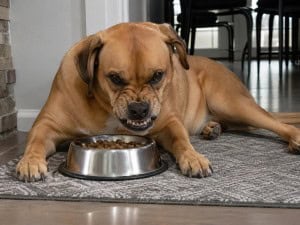
Why does my dog growl when I approach their food bowl? It’s one of the most common questions the team at Dances with Dogs hears from Miami-area dog owners. You walk into the kitchen to refill the water bowl, and a low, steady rumble from across the room stops you in your tracks. Your dog is eating, and that growl feels like a threat. A confused owner wonders if their dog is dangerous, defective, or just plain mean. The answer is almost always none of the above. What you’re witnessing is food guarding: it has a clear biological explanation, a predictable pattern, and a structured path to resolution.
This article walks you through the instinctual science behind why dogs guard their food, how to read the warning system your dog is already using, what you should never do in response, and a staged training approach that actually shifts the behavior. If you’re also wondering when to loop in a vet or certified trainer, that’s covered too.
Why does my dog growl when I approach their food bowl?
Why guarding resources is hardwired, not a personality flaw
Food guarding is not defiance, dominance, or a sign of a broken dog. It is a survival behavior refined over evolutionary time. Before domestication, dogs that protected their food lived to eat another day, those who freely shared got outcompeted. The instinct to guard a resource was adaptive, and it runs deep. Understanding this is the most important mindset shift an owner can make. Once you stop framing growling over food as disrespect and start framing it as biology, you can actually do something about it.
What actually triggers the growl
Specific contextual triggers reliably push a dog over threshold near the food bowl. Approaching while your dog is mid-meal, leaning over the bowl, another pet entering the feeding space, or children moving unpredictably nearby are the most common ones. High-value food raises the stakes considerably: wet food, bones, and chews tend to produce faster, more intense guarding responses than a plain bowl of dry kibble. Dogs who came from litters competing at a communal bowl, or who experienced food scarcity as strays or in shelter environments, often have a lower guarding threshold than dogs raised in stable homes from puppyhood.
How genetics and early life shape the response
Certain breeds show stronger tendencies toward resource guarding due to their working history, but individual variation is real and significant. Not every rescue dog guards food, and some dogs from stable homes guard intensely. Genetics set the baseline, and early experience shapes the expression. Each dog needs to be assessed on their own behavior history, not stereotyped based on breed or background.
The warning system your dog is already using
Reading the escalation ladder before the growl
The growl is not the beginning of the sequence. By the time your dog growls, they have already communicated discomfort in several ways: eating faster, body stiffening, a hard direct stare, whale eye (the whites of the eyes visible at the corners), and freezing in place. After the growl comes a snap, and after a snap comes a bite. Owners who miss the earlier, subtler signals often experience what feels like an “out of nowhere” bite, but the dog was broadcasting warnings the entire time. Learning to read the full escalation ladder is what keeps everyone safe. For more on the typical signs and progression of food guarding, see the ASPCA’s guide to food guarding.
What the growl is really saying
The growl is functional communication. Your dog is signaling: “Your proximity right now is making me uncomfortable.” Think of it as a yellow traffic light, not a red one. A dog that is still growling is still trying to avoid a conflict, and that distinction matters enormously for training. The goal is not to eliminate the warning signal. The goal is to change the emotional state driving it, so your dog no longer feels the need to warn you in the first place.
Why punishing the growl makes food bowl growling worse
Suppressing the signal doesn’t change the emotion
When owners scold, alpha-roll, or physically correct a growling dog, the dog does not learn to feel safe near their bowl. Instead, the dog learns that growling brings punishment and stops growling. The underlying discomfort stays completely unchanged. What follows, often without warning, is a snap or bite the owner never saw coming, because the dog learned to suppress its communication rather than resolve its stress. This is the most critical safety point in this entire article: removing the growl without addressing the emotion beneath it creates a more dangerous dog, not a safer one.
What the science says about punishment here
The AVSAB’s 2021 position statement on humane dog training states that aversive methods, including punishment, rejection, and physical corrections, worsen fear-driven behaviors by layering additional anxiety on top of an already anxious response. Dog food aggression and possession aggression are fundamentally driven by the dog’s perception of threat. Responding with more threat does not reduce that perception. Counter-conditioning works because it changes the emotional association entirely: instead of “this person approaching my bowl is a threat,” the dog learns “this person approaching my bowl predicts something better arriving.”
Immediate steps to keep everyone safe right now
What to do (and not do) in the moment
Back away calmly and give your dog space to finish eating. Do not reach into the bowl, do not correct the growl, and do not try to “take the bowl away to show them who’s boss.” That approach rehearses the exact confrontation that makes guarding worse. Pick up the empty bowl only after your dog has walked away from the feeding area on their own. Your immediate job is to reduce conflict while a training plan is set up, not to resolve the behavior through willpower or force.
Setting up the feeding environment to reduce guarding triggers
Environmental management does not fix resource guarding, but it prevents the behavior from being rehearsed while a training plan is in progress. Feed your dog in a low-traffic, low-stimulus area and use a closed door, crate, or baby gate to keep other pets or children out during mealtimes. Feed on a consistent schedule: predictability reduces anxiety, and an anxious dog guards more intensely. Children should never approach a dog’s bowl unsupervised, regardless of how food-friendly the dog normally appears.
When sudden-onset growling signals a medical problem
If food bowl guarding appears suddenly in a dog with no prior history of it, schedule a vet visit before starting any training protocol. Pain, including dental disease and gastrointestinal discomfort, can make a dog defensive around food almost overnight. Conditions such as hypothyroidism, liver disease, and certain neurological issues have also been linked to sudden behavioral changes involving irritability and resource defense. Rule out the physical cause first. Training a dog in pain will not resolve the behavior, and it may worsen both the pain and the guarding. Your veterinarian can help rule out pain-related causes; see VCA’s overview of food bowl aggression for more.
How to stop growling when I approach their food bowl: a staged training plan
Stage 1: Building a positive association with your approach
The foundation of any effective food guarding protocol is desensitization: starting at a distance where the dog shows zero stress, then building positive associations with your presence near the bowl. Stand several feet away while your dog eats and toss a high-value treat toward the bowl every few seconds. You are not interrupting the meal. You are teaching your dog that a person approaching predicts something better arriving, not a loss. A commonly recommended guideline is to advance to the next stage only after roughly ten fully relaxed, stress-free meals at the current distance. Rushing this stage is the most common reason home training stalls. For additional step-by-step guidance and clinical perspectives on resource guarding protocols, see the Preventive Vet guide to resource guarding.
Stage 2: Progressive proximity and counter-conditioning at the bowl
Once your dog is consistently relaxed at a distance, begin closing that gap across multiple sessions: stepping closer, then reaching toward the bowl, then touching it briefly, then lifting it slightly before immediately returning it with a high-value treat added. At every stage, your dog’s emotional state is the measure of progress, not a fixed timeline. The behavioral goal is a dog who looks up calmly when you approach, because experience has taught them that your arrival makes the meal better. Progress built this way tends to hold.
How certified force-free trainers handle cases that don’t resolve easily
The team at Dances with Dogs uses structured desensitization and counter-conditioning protocols tailored to each dog’s specific guarding threshold, history, and household context. The goal is never simply to eliminate the growl, it is to resolve the emotional state driving it. Eliminating the warning signal without addressing the underlying anxiety produces a dog that bites without warning, which is a worse outcome than where you started. For Miami-area dog owners dealing with food guarding, a professional consultation means working through a safe, staged protocol with someone who knows exactly when to advance, when to backtrack, and when additional support is needed.
When to call a certified trainer or your vet
Signs the behavior is beyond a DIY training plan
Some situations call for professional help from the start, not as a last resort. If your dog has already snapped or bitten, if children or elderly people are in the household, if the guarding is escalating across multiple resources beyond the food bowl, or if your dog shows no relaxation even at maximum distance in stage one, stop the home protocol and contact a professional. Unguided trial-and-error at that stage carries real risk, and the stakes are too high to troubleshoot alone.
What to look for in a qualified professional
Look for trainers holding credentials from recognized bodies: KPA CTP (Karen Pryor Academy Certified Training Partner) or IAABC (International Association of Animal Behavior Consultants). For severe cases, a board-certified veterinary behaviorist (DACVB) is the appropriate level of care. Force-free methodology is non-negotiable for resource guarding cases, as explained earlier, punishment-based approaches consistently worsen dog growling while eating and related food aggression behaviors. For dog owners in the Greater Miami area, Dances with Dogs offers behavior consultations grounded in the same science this article outlines, with the hands-on experience to build and supervise a safe protocol from assessment through resolution.
The path forward starts with understanding
If you’ve been asking yourself, “Why does my dog growl when I approach their food bowl?”, the answer is not a character flaw or a sign of a dangerous dog spiraling out of control. It is an instinctual survival behavior with a clear communication pattern and a trainable emotional foundation. The growl itself is information, and treating it that way is what makes resolution possible.
The path forward follows a clear sequence: understand the trigger, manage the environment immediately to stop rehearsal of the behavior, rule out any medical causes with your vet, and then follow a staged desensitization and counter-conditioning plan where your dog’s relaxation, not a fixed schedule, sets the pace. For households with children, dogs that have already bitten, or cases where guarding is spreading to multiple resources, a certified force-free trainer is the right next step before anything else.
If you’re in the Miami area and dealing with food guarding or other resource-related behaviors, the Dances with Dogs team offers behavior consultations built on these principles. Just like the dog in that opening scenario, most dogs showing possession aggression or growling over food are not beyond help, they’re waiting for the right approach. Reach out to discuss what your dog is showing you and what a structured, humane plan looks like for your specific situation.
Katie Casell (KPA CTP, CPDT-KA, CSAT, FFCP, FDM, CPPS) is the founder of Dances With Dogs and a force-free trainer with over two decades of experience helping families build lasting bonds with their dogs. Her team of trainers, walkers, adventure specialists, and cat sitters is known for detail-oriented, reliable care that never uses fear or pain.