
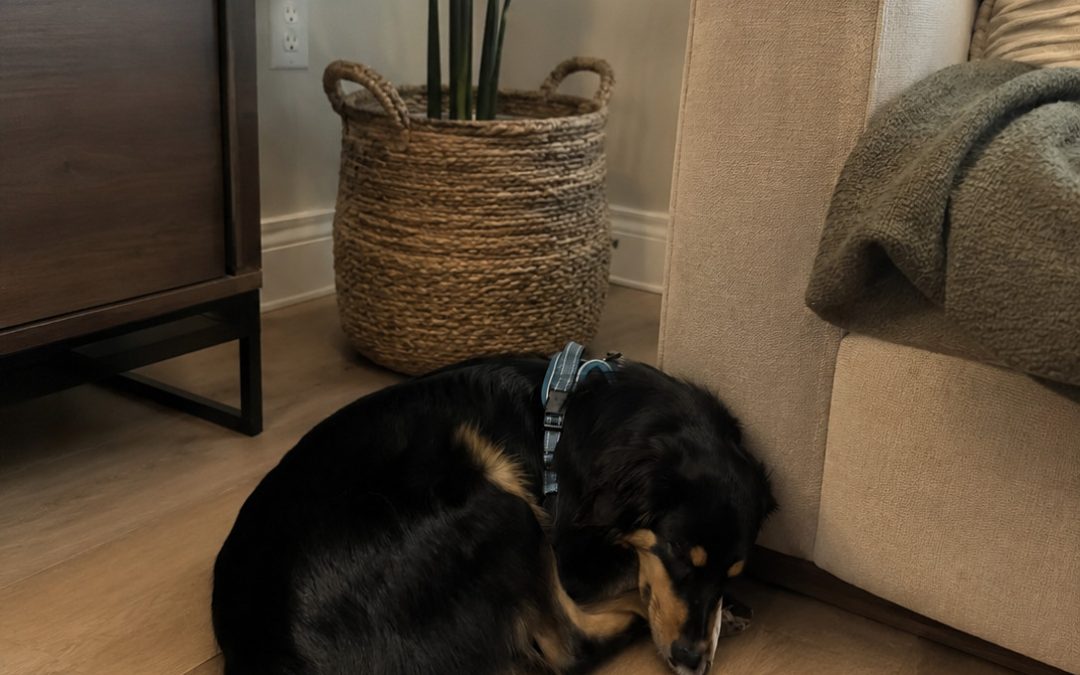
A tightly curled dog is conserving heat, protecting her belly, and staying ready to move. Watch for the day she stretches out.
We have been getting a lot of these calls lately.
Someone brings home a newly adopted dog from the Miami-Dade shelter or a local rescue. A week later, they call us because the dog is hiding, will not eat, bolts at the slightest sound, or has decided the husband is terrifying. The person calling is usually somewhere between worried that things will never change and believing we are their last hope before the dog gets returned. Guilt is often in there too, because part of them wonders whether they made a mistake, and they feel awful for even thinking it.
These calls are hard, and not because the dogs are difficult. They are hard because a lot of the time the honest answer is that the dog needs more time. A week, ten days, a month is not enough for some dogs.
This is not meant to be blase. Sometimes there are real behavioral problems that need to be addressed, and we say so clearly, because waiting on certain things makes them worse. But far too often what the caller is describing is a dog in the middle of a decompression period, and the most useful thing we can do is explain what that is before anyone makes a decision they cannot undo.
You looked through the profiles online and picked the dog you thought would be perfect for your family. You did the research, set up the crate, bought the best food, and got the cute bowls, matching leash, and collar. And now there is an animal in your living room who will not eat, will not look at you, or has decided your furniture is a chew toy and a launching pad. This is not the dog of your dreams, and not the dog you met at the rescue.
Here is the part that doesn’t always get told at pickup: the dog you brought home is not the dog you adopted. The dog you adopted will show up in a few weeks, or even a few months. What you are living with right now is a nervous system in the middle of a very large adjustment. The dog decompression period is the time between arrival and when a dog’s behavior actually reflects who they are.
Understanding this will change almost every decision you make in the first month.
What the dog decompression period actually is
Decompression is not a training concept. It is a physical one.
Losing a home, riding in a stranger’s car, living in a shelter, and then landing somewhere brand new are all big changes, and a dog’s body responds to big changes the same way ours does. It floods with stress hormones. The main one is cortisol, and researchers have measured it in shelter dogs for decades. The pattern is consistent: cortisol spikes in the first days after a dog arrives somewhere new, then comes down slowly as the dog gets used to the place.
Slowly is the key word. Cortisol does not shut off the moment a dog lands somewhere better. It drains out over days and weeks, and while it is still high it can make your dog act in ways that look like personality but aren’t.
High stress hormones mess with appetite, sleep, digestion, and body temperature. Most importantly, they lower the point at which a dog reacts to things. A stressed dog jumps at noises she would normally ignore, takes much longer to calm back down, and has real trouble learning anything, because a brain that thinks it might be in danger puts its energy into scanning for threats instead of remembering lessons.
None of that is your dog being stubborn or testing you. That is a dog whose body is temporarily running the show. So when you look at her and think, this animal is not herself, you are right, and not in a poetic way. Something measurable is going on.
The 3-3-3 rule and where it falls apart
You have probably heard of the 3-3-3 rule: three days to decompress, three weeks to settle and learn the routine, three months to feel at home. It came out of the rescue world for a good reason. Rescues watched dogs get returned in week one by people who expected a finished pet, and they needed something short enough to quickly explain that a new dog needs time. It worked. That rule has almost certainly kept a lot of dogs in their homes, and the people who share it are doing right by dogs.
So I am not here to tear it down. I want to be clear about what it can and cannot tell you.
The numbers were never research. They are a memory aid, chosen because they are easy to repeat, and trouble starts when people read them as a schedule instead of a nudge toward patience. That causes two very real problems.
First, three days is far too short. Studies following adopted dogs into their new homes have found meaningful change well past the first month, with a dog at six weeks looking noticeably different from that same dog in week one. Three days is barely the shutdown phase, which is something else entirely.
Second, dogs do not run on schedules. A confident four-year-old Lab coming out of a foster home may be settled in ten days. An undersocialized street dog flown in from another country may need four months before you see anything close to a baseline. Genetics, early socialization, age, prior history, and the size of the gap between the old life and the new one all move the timeline, and none of them are on the handout.
Keep the patience the rule is asking for. Hold the numbers loosely.
Kensi took a year
I want to tell you about a dog, because the timeline question is not abstract for me.
Kensi was picked up by the county shelter as a stray on the streets of Miami at about six months old. A well-meaning woman pulled her and placed her with someone she knew. That person returned her. The woman was notified, went back, got her, and placed her again. That home returned her too. This happened over and over. The last home before ours kept her six months, long enough that everyone assumed it had stuck, and then returned her as well. At that point, a rescue got wind of the situation and pulled her into their program.
We were her sixth home. She was somewhere between a year and a half and two years old.
It took a year before she was genuinely comfortable. Not two weeks, not three months. A year. For a long stretch of that year you could see her doing the math every time the routine changed. She had learned something entirely reasonable from her history: homes are temporary, and the car sometimes goes to the shelter. Nothing about that belief was irrational. It was the most well-supported conclusion available to her based on the evidence she had.
I cannot point to a single day it changed, but I can point to the thing I noticed.
She slept in a crate at first, only because we didn’t yet know whether she was house-trained. Once we were sure, we let her sleep wherever she wanted, and what she wanted was the foot of our bed. She took that spot every night for the rest of that first year, curled in a tight ball. Without exception.
Then one night I looked down at the end of the bed, and she was flat on her back, belly exposed to the room, sound asleep.

Kensi, one year in. She spent that whole first year curled in a tight ball at the foot of our bed. Then one night, this.
That posture is not a preference. A curled dog conserves heat, keeps the abdomen covered, and can get on her feet in one motion. Supine gives up all three at once. A dog cannot decide to sleep that way. It happens when the system finally stops holding something in reserve.
If you are waiting on a new dog right now, that is the kind of thing to watch for. Not obedience, not affection, not whether they come when called. Watch how they sleep.
What I found most useful, and what I now watch for in client dogs, is that she settled at home well before she settled anywhere else. The house came first because it was predictable and we controlled most of what happened in it. Out in the world she stayed uneasy much longer. Safety does not generalize all at once. It gets built context by context, and novel environments come last, because that is where a dog has to trust the pattern holds in a place where nothing guarantees it will.
This is the trap for adopters. You see the dog sprawled on the couch, decide decompression is finished, and then feel blindsided when the same dog is brittle at the vet or on an unfamiliar trail. She is not regressing. You won one context and haven’t won the others yet.
Kensi eventually became my helper dog for cases involving dog reactivity, which required a steadiness and neutrality that would have been unimaginable in her first year with us. The dog who arrived expecting to be sent back turned into the dog other dogs could safely practice on.
If I could replicate her, I would.
The two phases most people misread
Most new adopters run into one of two things, and both get misinterpreted.
The shutdown dog. The new dog arrives quiet and undemanding. They lie down where you put them. They don’t bark, they don’t counter surf, they don’t jump on visitors. Adopters tell me their new dog was “so easy” and “such a good boy” at first, and then they are blindsided when that same dog starts eating the couch or guarding it.
Nothing about the dog changed. The shutdown was an inhibited state common in animals under intense stress. The behavior is suppressed, not gone, and the feelings underneath it were never suppressed at all. As cortisol normalizes and the dog begins to feel safe, the full behavioral repertoire comes back, including the parts that are inconvenient. This is not regression. It is the opposite. Your dog is relaxed enough to stop hiding.
The dog who can’t stop moving. The other pattern is the dog who arrives loud, frantic, mouthy, unable to settle, pacing at 2 a.m. This is the dog who gets called hyperactive, or anxious, or too much for this household, and the label sticks long before anyone has enough information to apply it. Being on constant alert and struggling to switch off are exactly what a stressed nervous system looks like. They are also, in most cases, temporary.
Both dogs are showing you the same underlying issue from opposite directions. Neither is showing you their personality.
Four things that actually shorten decompression
The interventions that help aren’t glamorous, which is why people skip them and start training instead. Training feels productive. It just does not work yet.
Sleep, in quantity. Adult dogs need about twelve to fourteen hours of sleep per day, and new dogs often get far less because the household is excited and the environment is novel. Sleep deprivation degrades emotional regulation in dogs the same way it does in us. Protect naps aggressively. Give your dog a spot where no one will approach them, and enforce it with the humans, not the dog.
Predictability. Dogs love patterns because a predictable world is one they do not have to keep monitoring. Feed at the same times, walk the same route, and keep the group of people your dog interacts with small at first. Predictability tells a brain it doesn’t have to stay on high alert. Save the introductions to your friends and their dogs for later, and tell the kids their friends can meet the dog once she has had a chance to acclimate.
Agency. Let your new dog make choices. Don’t force greetings, don’t reach into the crate, don’t pull them toward things they are avoiding. Perceived control is one of the most reliably stress-reducing variables in the animal welfare literature. A dog that learns it can leave a situation doesn’t need to escalate to leave it.
Nose work and enrichment. Nose work is not a nice extra. When a dog gets to use her nose, her body shifts into rest-and-digest mode, and studies on scent work and foraging enrichment have measured real drops in stress. A slow, long-line walk in a low-traffic environment where the dog sets the pace does more to decompress a dog in twenty minutes than a structured obedience session does in a week. This is the entire premise behind decompression walks, and it is why we built that service the way we did.
What to skip until your dog has settled
How long is until? Longer than you want it to be, and you will know by watching rather than by counting. Look for sleeping soundly, eating normally, and moving around the house without checking on you.
That means no group classes, no dog parks, no obedience drills. No visitors beyond a handful of close friends and family. No grooming appointments unless medically necessary. No testing them with the resident cat.
Do work on husbandry, name response, and simple pattern games, all of it low-pressure and rewarded with food.
Do get a veterinary exam, but think about the timing. Pain drives behavior, dogs are good at hiding it, and I have watched people spend two months on behavior work for a dog whose real problem was a sore hip. So the exam matters. It is also a hard outing for a dog who just got here, with strangers handling her, a lobby full of dogs, and a building that smells like nothing good ever happened there.
Go right away if anything medical is in play: coughing, diarrhea, vomiting, limping, not eating past a day or two, or anything that looks like discomfort. Shelters are crowded, and respiratory bugs and parasites spread easily. Check your adoption contract too, because many require an exam within the first week or two for the health guarantee to hold. If none of that applies, you have room to wait a little and set the visit up properly. Book the first or last slot so the lobby is empty, wait in your car until they are ready for you, tell the front desk your dog came home from a shelter a few days ago so the team can adjust, and look for a Fear Free certified practice if there is one near you. If your dog is already struggling, ask your vet about medication to take the edge off rather than pushing her through it.
Training classes and behavior work are two different things
I had this conversation just last week.
A woman called about a dog she had adopted from a local shelter. The shelter includes six free training sessions with adoption, so she had signed up right away and was working through them: sit, down, stay, loose leash walking. She was doing everything asked of her.
The problem was that her dog was scared. Not aggressive, and I want to be careful with that word, because nobody had been growled at or snapped at. This dog was simply running away. Someone would reach out to pet her, and she would leave. That is a dog saying no in the politest way available to her, and the good news is that she had somewhere to go and was allowed to take it. A dog who can leave usually does not need to escalate.
She had already figured out that sit was not going to fix that. Someone she was working with pointed her toward us, and she called knowing she needed something different from what she had.
Most people don’t get there that fast, and I don’t blame them. The difference is not always obvious from the outside.
Let me start with the obvious. Free or subsidized training attached to an adoption is one of the better things happening in this county, as long as the training is force-free and the dogs are having fun too. It keeps dogs in homes, it lowers the barrier for people who could not otherwise afford help, and I am glad it exists. Nobody should skip it.
But two things about it get misunderstood, and the second one was in play on that phone call.
The first is category. Those sessions teach manners, and manners are worth having. What manners training doesn’t do is change how a dog feels. Sit is a behavior. Fear is an emotion. Teaching a scared dog to hold a down stay while the thing that frightens her walks past does not make her less frightened. It makes her a frightened dog holding still, and sometimes it makes matters worse, because now she has lost the option to move away.
Changing how a dog feels is behavior modification. It is a separate discipline with separate protocols. Counterconditioning, desensitization, and management are not advanced obedience. They are different tools for different problems.
The second is timing, and this is the one almost no one thinks about. Free does not mean now. A group class puts a dog in a room with unfamiliar dogs at close range, in a novel building, with no real ability to leave. For a confident dog three weeks post-adoption, that’s fine and probably good. For a dog who is still running high cortisol and has not yet decided whether the house is safe, it is a lot to ask, and it is being asked at the exact time she has the least capacity to handle it. Learning is also inefficient in that state, so you are spending sessions you will wish you’d saved.
So if you have adopted a dog and the shelter offers free training, call and ask whether you can push the start date out. In my experience, most will say yes, because they want the training to work as much as you do. Use the weeks in between for decompression, and go to those sessions when your dog will actually get something out of them.
And if you have already finished the six sessions and your dog sits perfectly but still flattens at the slightest sound, nothing has failed. You were given a good tool that was built for a very different job. That’s when you bring in someone who does behavior work.
When it isn’t decompression
Patience is the right default, but it is not the right answer to everything. Some things don’t improve with time and get worse the longer you wait.
Call a qualified professional now, not in a month, if you see any of this:
Growling, snapping, air snaps, or a hard freeze. None of these are the problem. They are your dog telling you she has no other options, and they warrant a phone call precisely because nothing has happened yet. Please do not correct a growl. A dog who learns that growling gets her in trouble is a dog who skips it next time, and that is how you end up with the bite everyone calls unprovoked.
Stiffening over food, a chew, a toy, or a spot on the couch, especially with a hard stare or a lowered head.
Distress when left alone that is getting worse rather than better, and anything that looks like injury from trying to escape a crate, a door, or a window.
A dog who cannot recover after a startle. A minute or two is normal. Twenty is not.
Any bite, at all, with or without broken skin.
And call your veterinarian rather than a trainer if your dog stops eating for more than a day or two, or if a behavior shows up suddenly in a dog who was fine last week. Fast onset points to the body first.
The question that matters is whether things are heading in the right direction. Decompression is messy. You get a good week, then a bad Tuesday, then two decent days. But if you compare where your dog is now against where she was a couple of weeks ago, you should see some improvement, even if it is small. A real behavior problem does not do that. It stays put, or it gets worse. So if you are a month in and nothing has moved at all, you are not waiting out decompression anymore, and waiting longer is not going to fix it.
A note for Miami adopters
Two local things worth mentioning. Heat is the first. A dog who is stressed and adjusting to South Florida heat and humidity is managing two physiological demands at once, so walks should be early in the morning and later in the evening, and they should be short. Check the ground temperature by putting the back of your hand on the sidewalk where you plan to walk. If you cannot hold it there for seven seconds, it is too hot for your dog.
The second is density. Most of Miami-Dade means neighbors, elevators, and delivery traffic. Finding genuinely quiet space takes intention, and it is worth the drive as long as your dog is comfortable in the car.
What I tell people
Stop trying to figure out who your dog is. You won’t get an accurate read for a few weeks, and anything you decide before then is a conclusion about stress, not about her.
Your job right now isn’t to train her, fix her, or evaluate her. It is to be boring, consistent, and safe, and to let her settle on her own schedule.
The dog you actually adopted is in there. For most dogs, it takes a few weeks. For some, it takes a year. Kensi was worth the year, and I have never met anyone who regretted being patient.
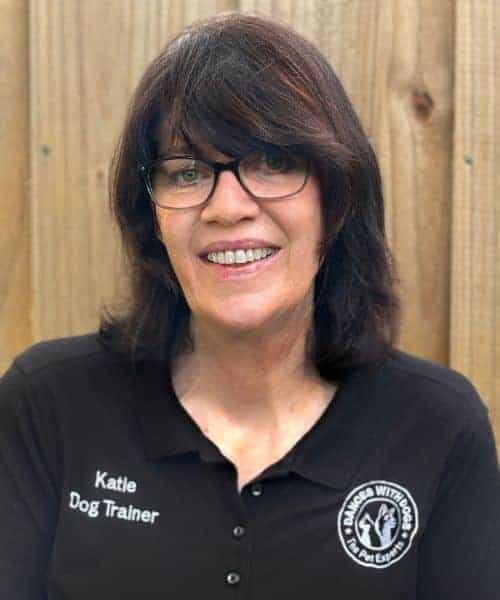
Katie Casell (KPA CTP, CPDT-KA, CSAT, FFCP, FDM, CPPS) is the founder of Dances With Dogs and a force-free trainer with over two decades of experience helping families build lasting bonds with their dogs. Her team of trainers, walkers, adventure specialists, and cat sitters is known for detail-oriented, reliable care that never uses fear or pain.