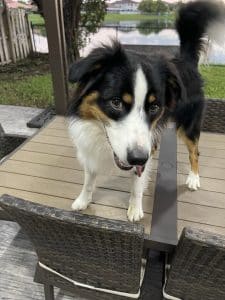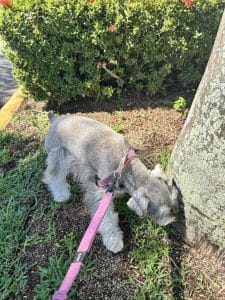
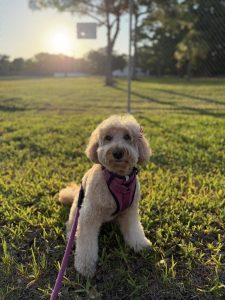
Early morning is the safest time to walk your dog through Miami’s summer heat.
If you have lived in Miami for more than one summer, you already know the drill. By 9 a.m. the sidewalk is hot enough to cook an egg, the humidity wraps around you like a wet towel, and your dog is panting before you even leave the driveway. Summer dog care in South Florida is a whole different sport than anywhere else in the country, and the rules matter.
This guide covers everything Miami dog parents need to know: exactly when it is and is not safe to walk your dog by month, indoor pet-friendly field trip options for the hottest days, how to turn your morning walk into a productive training session, what to pack on every outing, and how to recognize and respond to heatstroke before it becomes a crisis.
Miami’s Heat Timeline: When Is It Actually Safe to Walk Your Dog?
The general rule of thumb is the pavement test: press the back of your hand to the asphalt for seven seconds. If you cannot hold it there comfortably, your dog cannot walk on it safely. Paw pads burn faster than human hands. That is the floor, not the ceiling.
But Miami adds another layer: heat index. A 90-degree day with 85 percent humidity hits a dog’s body more like 105 degrees. Here is a month-by-month breakdown of what safe looks like in Miami-Dade:
| Month | Safest Walk Windows | Notes |
| November to February | 6 a.m. to 10 a.m. | 5 p.m. to 7 p.m. | Miami’s safest window. Evening walks are genuinely comfortable. |
| March to April | 6 a.m. to 9 a.m. | 5:30 p.m. to 7 p.m. | Temps rising. Begin monitoring pavement by 9 a.m. |
| May | 6 a.m. to 8:30 a.m. | 6 p.m. to 7:30 p.m. | Humidity spikes. Shorten walk duration. Check paws after. |
| June to September | Before 7:30 a.m. | Peak danger. Afternoon walks are off the table. Shade is non-negotiable. |
| October | 6 a.m. to 9 a.m. | 5:30 p.m. to 7 p.m. | Hurricane season tail end. Watch for heat rebounds after storms. |
One more consideration Miami dog parents often miss: brachycephalic breeds (French Bulldogs, Pugs, Boston Terriers, Boxers) and senior dogs need even tighter windows. For those dogs, June through September means morning-only walks, kept under 20 minutes, with water at every five-minute mark.
Beat the Heat: Indoor Field Trips for Miami Dogs
Some days, the heat index makes any outdoor adventure a bad idea, even at 7 a.m. That does not mean your dog has to stay cooped up at home. A change of scenery, new smells, new sounds, and a little gentle novelty go a long way for a dog’s mental stimulation, and several major retailers welcome well-behaved, leashed dogs inside their air-conditioned stores. We call these field trips, and we build real training value into every one.
The goal is not just to let your dog wander the aisles. Use the trip deliberately: practice loose-leash walking around novel distractions, work on a settle near the checkout line, or simply let your dog experience a new environment in a calm, controlled way. Here are four reliable options across Miami-Dade.
1. Petco
Petco has a long-standing leashed-dog-friendly policy at most locations, making it one of the easiest indoor field trips to work into a routine. Wide aisles give you room to practice loose-leash walking without crowding, and the sheer volume of new smells (other pets, treats, toys) makes it a great low-stakes way to build focus around distraction. Bring high-value treats and keep sessions short, ten to fifteen minutes is plenty for most dogs.
2. PetSmart
Similar policy to Petco, and often slightly larger store layouts, which gives dogs that need more space to decompress a little extra room to settle in before working. PetSmart locations frequently host adoption events or grooming traffic near the entrance, which (at a comfortable distance) can be useful for dogs working on calm behavior around novelty and other animals.
3. Home Depot
Home Depot has a nationwide leashed-pet-friendly policy, and the environment is genuinely useful for training. Concrete floors, forklifts, paint mixers, and unusual textures and sounds make it an excellent place to build a dog’s confidence around novel stimuli in a low-pressure way. It also doubles as a great location to practice a default settle while you browse, since most trips naturally involve some standing around.
4. Lowe’s
Lowe’s shares a similar leashed-pet policy and gives you a natural rotation option so the same dog is not visiting the identical environment every time. Variety matters for generalization, a dog who is calm and focused at Home Depot but falls apart at Lowe’s has not actually generalized the skill yet. Rotating between a few stores each week builds a more reliable, adaptable dog.
A few ground rules for any indoor field trip: confirm the specific store location still allows pets, since policies occasionally vary by franchise owner or have changed since this was written. Keep your dog leashed at all times, bring your own treats rather than relying on samples, and skip the trip entirely if your dog struggles with focus around food, carts, or strangers in tight spaces. The goal is a positive, confidence-building outing, not a stressful one.
How to Turn Your Morning Walk Into a Training Session
Morning walks are not just for bathroom breaks. Between 6 and 8 a.m., before the heat climbs and the neighborhood wakes up, you have the single best training window of the entire day. Fewer dogs, fewer bikes, fewer distractions. A dog whose nervous system is not already flooded by stimulation is a dog who can actually learn.
Here are three techniques we integrate into every walk:
Loose-leash check-ins. Every time your dog drifts back to glance at you without being asked, mark it (a verbal yes or a click) and reward. You are building the habit of your dog choosing to stay connected. Keep your leash J-shaped as your goal. The moment it goes taut, stop moving. The moment slack returns, you move forward. Consistency over a few weeks builds dogs who genuinely prefer walking close.
Name response on the move. Say your dog’s name once while walking. If they look up at you within two seconds, mark and reward. If they do not, make a quick noise (a gentle smack of lips or a quiet squeaky sound) and reward the look when it comes. This is one of the highest-value behaviors you can build because it underpins every other recall and attention skill.
Environmental sits and downs. Every time you stop at a corner or pause on the trail, ask for a sit. Do not wait until they are bouncing. Ask before the energy builds. Over time, dogs begin to offer the sit automatically at stopping points, which is exactly the kind of default behavior that makes everyday life easier.
The key is keeping sessions short and the dog in a learning mindset. Five to eight minutes of deliberate training during a 30-minute walk is plenty. The rest of the walk should be decompression: sniffing, exploring, moving at the dog’s pace.
What to Pack for a Miami Dog Walk
A Miami summer walk requires more preparation than a walk in most other cities. This is our standard kit:
- Water, more than you think. A minimum of 8 oz per 20 minutes of activity for a medium-sized dog. Carry a collapsible silicone bowl, or a squeeze bottle they can lap from.
- Booties. If your dog will tolerate booties, they are the gold standard. Make sure they are heat rated.
- A cooling bandana or vest. Soak, wring, and apply around the neck or torso. These work best when wet and lose effectiveness as they dry, so bring an extra or plan to re-wet, so bring extra water.
- Enzymatic wipes. For paw cleaning after any walk. Removes allergens, microorganisms, and environmental debris that accumulate on trail surfaces.
- A small first aid kit. Include tweezers for thorns (common on hammock trails), a tick remover, gauze, and the number for your nearest emergency vet.
- Your phone, fully charged. Maps, emergency contacts, and photos of your dog in case of separation.
One item people consistently forget: identification. If your dog slips a leash on a walk, a GPS collar or current ID tag shortens the crisis dramatically. Check your dog’s tags and microchip registration before every walking season.
Recognizing and Responding to Heatstroke in Dogs
Heatstroke in dogs is a genuine emergency. It progresses faster than most people expect, and the difference between a dog who recovers and a dog who does not often comes down to how quickly the cooling process begins.
Early warning signs
- Heavy, rapid panting that does not slow when the dog rests
- Excessive drooling or thick, ropy saliva
- Gums that are bright red or, in later stages, pale or grayish
- Disorientation, stumbling, or inability to stand steadily
- Vomiting or diarrhea
- Skin that feels hot to the touch, particularly around the ears and groin
Immediate first response
Move to shade or air conditioning immediately. Do not wait to see if they improve outdoors.
- Apply cool (not cold) water to the dog’s paw pads, groin, armpits, and neck. Avoid ice water, which causes blood vessels to constrict and actually slows cooling.
- Offer small sips of cool water if the dog is conscious and able to swallow. Do not force water and do not let them drink too much.
- Fan the dog while applying water to accelerate evaporative cooling.
- Call your veterinarian or an emergency animal hospital immediately. Do not wait to see if the dog improves on their own. Heatstroke causes internal damage that is not visible from the outside.
The target is to get the dog’s temperature below 103.5 degrees Fahrenheit before reaching the vet. A rectal thermometer is a worthwhile addition to your kit if you walk regularly in summer.
Summer Walks Are Possible, Just on Miami’s Terms
Miami is a genuinely incredible city to explore with a dog. The parks are beautiful, the water is everywhere, and the wildlife your dog will encounter on a hammock trail is unlike anything you will find in most of the country. The heat just requires a plan.
Early mornings, shaded trails, plenty of water, and a little training along the way: that is the Miami summer dog parent formula. It works, and it makes the walks better for everyone.
Want expert guidance on safe walks and training for your dog this summer?
Dances With Dogs has served Miami-Dade County since 2002. Our walks combine professional trainer-led movement with real-world behavior training, so your dog comes home calmer, more confident, and genuinely tired. Force-free, science-based, and built for Miami summers.
Learn more at danceswithdogs.com or contact us to schedule a consultation.

Katie Casell (KPA CTP, CPDT-KA, CSAT, FFCP, FDM, CPPS) is the founder of Dances With Dogs and a force-free trainer with over two decades of experience helping families build lasting bonds with their dogs. Her team of trainers, walkers, adventure specialists, and cat sitters is known for detail-oriented, reliable care that never uses fear or pain.