
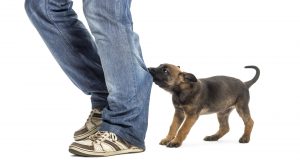
You are hosting a party for the first time in your new home. You are all excited and your dog’s tail keeps wagging non-stop because they too can feel something is about to happen. As the first guest arrives, all is well. You greet the next guest and offer them a drink. Just as you are welcoming a group of people, your dog comes bounding down the stairs but skids to a halt in front of the guests. One of your friends reaches out their hand to pet the dog and your fur baby growls low and suddenly nips at them. Startled, your friend cradles their bleeding hand, while you move your dog into another room.
Raise your hand if you have experienced this embarrassing situation?
Your gentle, sweet dog who likes to play fetch and loves cuddles, just bit your guest. How did you miss this aggressive behavior?
Before we get to that, there’s one thing you need to know ― when trying to rid your dog of aggressive action, you need to take a behavior modification approach. This type of force-free dog training focuses more on finding out the root cause of the problem rather than reprimanding the dog and using harsh training tactics.
Why Is Your Dog Nipping at Guests?
There are any number of reasons your dog might bite:
· Badly Treated Dog
If your dog previously lived in an abusive home, then they will have trust issues. Their withdrawn and frightened nature makes them suspicious of everyone, which is why they defend themself by nipping at others.
· Protecting Their Home
Your dog has found a “safety zone,” which they feel is threatened by the people coming in your house. It’s possible that the crowd is making them anxious and that’s why they are lashing out.
· Fear
Dogs do not like unpredictability. Having a stranger reach towards them, lean over them, or sneak up on them can cause a dog to lash out.
· Pain
Pain can also be a possible factor in a dog biting. As dogs age, arthritis can set in and make even a simple touch painful. Some illnesses can also be a source for pain, causing your dog to be on edge and ready to protect themselves from further discomfort.
These are only a few reasons a dog might lash out and bite.
Tips on Stopping Your Dog from Nipping at Your Guests
Now that you know some of the reasons your dog is acting so aggressively towards your guests, here’s how to modify their behavior:
Give Them Space
Put your dog in a separate room with their toys, food, and water. Give them toys that will occupy their brain. If they feel comfortable, they will come out on their own. This will give them the adjustment period they need to become familiar with the crowd.
When throwing a party at your house, which can be huge for your dog to take in, why not leave them on their own? Put them in another room or behind a baby gate so that they can safely stay in a confined space. Regularly check up on them to make sure they are doing fine. The loud noises might make them anxious and seeing your face will calm them down. Playing calming music may help. There are several options to choose from on Amazon
Monitor Your Dog’s Playful Behavior
Neglect on your part can also lead to this nipping behavior. When a dog playfully bites another dog, all play stops for a few minutes and they avoid each other. After a while, they resume playing.
Use this tactic to modify your dog’s behavior. When your dog is nipping at you playfully, stop the play session immediately. This will tell the dog that things got out of hand. Over time your dog will come to realize that they need to be gentler with their mouth. This will also temper the severity of their bite.
Allow your dog to socialize with people. Take them on long walks and meet with your friends in a park. Keep them close, but be relaxed and observe how they react when your friend raises their hand to pet them. If they feel threatened, they will growl, turn their head, lick their lips, show the whites of their eyes or move away and let you know they are not comfortable. If your dog is not nipping at an individual, give them a treat. This is a long drawn out process and will take some time and patience on your part. However, it will reinforce positive behavior. Do not use disciplinary measures to train your dog. If your dog continues to bite people despite using these tips then better remove them from the situation and contact a force-free trainer. You can also go for dog training online to help train for better behavior.
For dog training in Miami, visit the website Dances with Dogs. This service offers in-person as well as online dog training and cat sitting. To know more about their services or to schedule an appointment, call on 786-299-1552.

Katie Casell (KPA CTP, CPDT-KA, CSAT, FFCP, FDM, CPPS) is the founder of Dances With Dogs and a force-free trainer with over two decades of experience helping families build lasting bonds with their dogs. Her team of trainers, walkers, adventure specialists, and cat sitters is known for detail-oriented, reliable care that never uses fear or pain.
I have an 11yr. old Australian Shepherd who will bite when a guest stands up. One of our friends is a weekly dinner guest who Murphy adores but will still bite him in the thigh if he stands up, yet is in his lap and loving him if he is seated. We’ve had him since he was a puppy. He is fine away from the house except for bikers who he will bite.
Thank you for sharing this, and I am glad you reached out. I want to give you a useful answer, so I will be honest with you: this is a bite history, and bite cases need eyes on the dog in person. What I can offer here is a direction to head in and some things to put in place today.
First, please book a full veterinary exam, including a pain and orthopedic workup and a vision check. Murphy is eleven. Arthritis, spinal pain, hip or knee changes, and declining vision are common at this age and can change how a dog experiences sudden movement nearby. A dog who is happy in someone’s lap and then bites the thigh as that person gets up warrants medical investigation before anything else. Pain and startle look a lot like aggression from the outside.
Second, look at the pattern. Both of your triggers are motion. A person standing up is a fast vertical movement at close range. A cyclist is fast horizontal movement. Australian Shepherds are built to notice and control motion, and in some dogs, that instinct turns into grabbing at what moves. The fact that it happens with guests inside your home but not with people out in the world tells me context matters here, too. That is all useful information for the professional you work with, so write down every incident you can recall: who, where, what happened immediately before, and what Murphy did afterward.
Third, and most urgently, no one else should get bitten while you work through this. Some things to put in place now:
Manage the environment during guest visits. A baby gate, an exercise pen, or a leash attached to you gives you the ability to prevent the bite rather than react to it. Prevention is not failure. It is what buys you time to try to fix the underlying problem.
Change the routine with your dinner guest. As much as Murphy loves him, the lap is where the setup for the bite happens. Have Murphy settled on his own bed or behind a gate before anyone needs to stand.
Build in a warning system. Ask guests to say something before they stand, and move Murphy first. Never let a person rise out of a chair with Murphy loose beside them.
Please do not correct or punish growling, stiffening, or hard staring. Those are warnings, and they are valuable. A dog who learns that warning gets him in trouble often stops warning and goes straight to the bite.
For finding help, given the bite history I would start with a veterinary behaviorist if there is one within driving distance of you. You can search dacvb.org. If not, look for a credentialed professional with specific experience in aggression cases through iaabc.org or ccpdt.org. Ask directly whether they have worked bite cases and what methods they use. You want someone working with reward-based, fear-free methods. Aversive tools and corrections tend to suppress warning signals and make bite cases less predictable, not more.
One last thing worth saying plainly. A dog with a bite history carries real liability, and I would want you protected as much as Murphy. That is another reason to get a professional involved rather than working from advice on the internet, including mine.
This is workable. Eleven years old is not too late, and the fact that you have caught a clear, predictable pattern actually puts you ahead. Please keep everyone safe in the meantime, and I hope you find someone excellent in your area.