
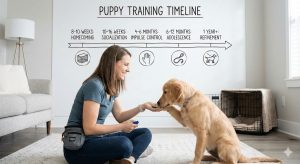
What to teach a puppy from the time you get them home into adulthood.
So, you brought home a puppy. Congratulations! You’re likely currently dealing with a mix of “new puppy smell” and “why is my rug wet?” But now you struggle with what to teach your puppy.
As a trainer with a background in animal behavior, I’ve spent years studying how dogs think. But I’ve also spent years in the trenches with owners just like you. I know you don’t want a lab report; you want a dog who doesn’t jump on your guests, comes when called, and can chill out while you’re eating dinner.
Think of this timeline as your “Puppy Roadmap.” We aren’t just teaching your dog to sit; we are raising a companion that fits into your life.
Phase 1: The First Two Weeks (8–10 Weeks Old)
The “Welcome Home” Foundation
Your puppy just left their mom and siblings. Their world just turned upside down. This phase isn’t about teaching them “High-Five”, it’s about making them feel safe and teaching them how your house works.
1. The “Potty” Habit
At this age, your puppy has a tiny bladder. Your goal is to be a “Potty Pro.” Take them out every 30-60 minutes after they eat, drink, play, and nap. When they go outside, throw a party! Immediately give them a treat and tell them they’re a genius.
The Secret: If they have an accident, don’t scold them. It’s just a data point that says you didn’t get them out fast enough. A great way to see where things are not working is to keep a log of when, where, and who was supposed to be watching the puppy. This will give you the information you need to set your puppy up for success.
2. Loving the Crate
Think of the crate as your puppy’s “bedroom,” not a jail cell. Put their favorite toys and treats in there. We want them to think, “This is my cozy spot.” A crate-trained dog is a dog that can travel with you to hotels or stay calm at the groomer and vet later in life.
3. Their Name is a Gift
Say your puppy’s name. When they look at you, give them a tiny piece of a yummy treat. We want their name to be the most exciting word they know.
Expert Tip: Avoid using their name when you’re frustrated. If you yell “Fido, NO!” they might start to think their name means they’re in trouble.
Phase 2: The Adventure Months (10–16 Weeks Old)
The “Social Butterfly” Window
This is the most important time in your puppy’s life. In the dog world, we call this the Socialization Window. Basically, your puppy’s brain is wide open to new experiences. If they have good experiences now, they’ll be confident adults.
1. The “Rule of 7.”
Try to let your puppy experience “7 new things” every week.
- 7 different surfaces (carpet, grass, wood, bubble wrap).
- 7 different types of people (kids, people in big coats, people with hats).
- 7 different sounds (the vacuum, a doorbell, a hairdryer).
2. Focus on “Soft Mouth.”
Puppies bite. A lot. It’s how they play and explore their world. But they need to learn that human skin is sensitive. If they nip you, stop playing and remove yourself from the situation for a few seconds. Do not scold or yell. You’re teaching them: “If you bite too hard, the fun stops.”
Phase 2: The Adventure Months (10–16 Weeks Old)
Basic Manners: Your First Real Conversations
By this stage, your puppy is starting to find their feet. This is when we move from just “surviving” to communicating. In my training programs, we begin with two foundational cues: Sit and Touch. After we get those two foundations down, we must continue with training, including eye contact, come when called, down, stay, wait, place, and learning to walk on a loose leash. Don’t wait until your puppy is older to get started.
I call these “conversation starters.” We aren’t demanding obedience; we are teaching your puppy that when they listen to a cue, good things happen.
1. The “Sit” Cue: The Foundation of Politeness
“Sit” is the universal sign for “please.” It’s the behavior we want our dogs to offer before they get their dinner, before we open the front door, and before they greet a guest.
-
How to teach it: Use a small, tasty treat to “lure” them. Hold the treat right at their nose and slowly move it back toward their tail. As their head goes up to follow the treat, their bottom will naturally go down.
-
The Pro Move: As soon as their tail-end touches the floor, say “Yes!” and give them the treat. We don’t push their bottom down; we want them to choose the position.
2. The “Touch” Cue: Your Puppy’s Secret Superpower
If “Sit” is the foundation, “Touch” (also known as hand targeting) is the “reset button.” You are teaching your puppy to boop their nose against the palm of your hand on cue.
-
How to teach it: Present your flat palm about two inches away from your puppy’s nose. When they lean in to sniff your hand, say “Yes!” and give them a treat from your other hand.
-
Why it’s a game-changer: This is far more than just a trick. Need your dog to get off the sofa? Need them to move away from the front door? Instead of pulling on their collar, which can cause neck damage and stress, present your hand and give the “Touch” cue. They follow your hand like a magnet. It turns a potential struggle into a fun game.
Why “Sit” and “Touch” Work Together
In the world of behavior science, we use these two cues to build focus. If your puppy is getting a bit rowdy or distracted by a passing squirrel, asking for a “Touch” followed by a “Sit” redirects their brain back to you.
By the end of this phase, your puppy isn’t just “behaving”—they are learning to look to you for guidance whenever the world gets a little too exciting.
Phase 3: Building “The Brakes” (4–6 Months Old)
Self-Control and Life Skills
Your puppy is getting bigger and bolder. We need to continue teaching them how to control their impulses. This is what separates a “pet” from a “partner.”
1. The “Invisible Leash” (Recall)
Coming when called is the most important safety skill. Start in your hallway. Call your puppy, and when they run to you, give them something amazing (like a piece of cheese). Never call them to do something they hate (like a bath). You want “Come!” to mean “Something great is happening!”
2. “Leave It.”
This is a life-saver. Teach them to look away from a dropped piece of food or a smelly shoe. This isn’t just about the “stuff”; it’s teaching your dog to check in with you before they react to the world.
3. The “Place” Cue
This is my favorite for owners who enjoy hosting dinner parties or need their dog to relax while they are busy. Teach your dog to go to a specific bed or mat and stay there. It’s their “home base.” While you’re eating dinner or working, they’re relaxing on their mat.
Phase 4: The Adolescent Shift (6–12 Months Old)
Focus: Consistency, Brain Remodeling, and Momentum
Welcome to the “teenager” phase. Between six and 12 months (Sometimes longer, depending on the breed of your puppy), your puppy undergoes a massive biological shift. Their brain is literally “remodeling” itself, pruning away old puppy connections and building adult ones, all while being flooded with hormones.
During this time, you might notice your dog suddenly “forgets” cues they knew perfectly last week, or they start testing boundaries. This isn’t “bad” behavior; it’s a biological renovation.
1. Navigating “Teenage” Regression
If your dog starts ignoring your “Sit” or “Stay” cues, don’t take it personally. Their brain is currently struggling to filter out the environment.
-
The Strategy: Temporarily increase your “paycheck.” Use higher-value treats (like small pieces of turkey or cheese) to help them focus through the hormonal fog. Keep sessions short (2-5 minutes), successful, and fun.
2. Mastering the Walk: The “300 Peck” Method
The biggest challenge for adolescent dogs is walking on a loose leash. The world is suddenly very exciting, and they want to get to everything now. Many owners get stuck in a “stop-and-start” cycle that just frustrates everyone.
Instead, we use the 300 Peck method. This technique builds momentum by rewarding your dog for the duration of their good behavior rather than just fixing a mistake.
-
Step 1: Take one step with your dog at your side. If the leash is loose, say “Yes!” and treat.
-
Step 2: Take two steps. If the leash stays loose, “Yes!” and treat.
-
Step 3: Take three steps. “Yes!” and treat.
-
The Reset: If they pull or get distracted at Step 4, don’t get frustrated. Just calmly stop, reset your dog to your side, and start back at Step 1.
By counting your steps, you are teaching your dog that the “pay” comes from staying with you, not from the “Yo-Yo” act of pulling and coming back. It turns the walk into a game of focus.
3. Distraction Proofing (The “Road Trip” Phase)
A dog might “Sit” perfectly in your kitchen, but can they do it at a busy park? This is called Generalization. Dogs are very specific learners; they don’t automatically realize that the rules at home apply at the beach or the pet supply store.
-
The Goal: Take your training on the road. Practice your “Touch,” “Sit,” and “Leave It” cues in 5 different locations this month. Start in quiet areas and slowly move toward busier ones.
Phase 5: The Young Adult (1–2 Years Old)
Polishing the Diamond
By now, the “puppy crazies” are starting to fade. Your dog is becoming a reliable adult. This is the time to refine their skills so you can enjoy total freedom.
1. Off-Leash Reliability
If you’ve been consistent with “Come when called,” you can start practicing in safe, fenced-in areas. A dog that can be trusted off-leash gets to live a much bigger, more adventurous life. A word of caution, not every dog will be able to be off-leash. If your dog has a high prey drive for small critters like squirrels, or if your dog is fearful, you may want to use a long line to prevent your dog from chasing prey or from trying to escape a scary situation by running away.
2. The “Off-Switch.”
By now, your dog should know how to settle. If you’re busy working, they should be happy to nap at your feet. We reinforce this by rewarding them whenever we “catch them being good” (lying down quietly).
3. Give Them a Job
Smart dogs need mental exercise. Try a “scent work” game where they find hidden treats, or teach them advanced tricks like “Fetch my slippers.” A fulfilled dog is a happy dog, and a happy owner!
Three Secrets to Success (The Science Part)
I know you’re busy, so if you only remember three things about how dogs learn, make it these:
- Rewards Work Better Than Punishment: Think of it like a paycheck. You work harder for a boss who gives you a bonus than for a boss who yells at you. Your dog is the same. Rewards build a dog that wants to listen.
- Be a “Predictable” Human: Dogs love routines. If “Sit” results in a treat or a pat, they will keep doing it. If you’re inconsistent, they get confused.
- Keep It Short: A puppy’s attention span is about as long as a TikTok video. Do five 2-minute training sessions a day rather than one long, boring hour.
Common Myths to Ignore
As you go through this timeline, you might hear some “old school” advice. Here’s what the science actually says:
- “You have to be the Alpha”: False. You don’t need to “dominate” your dog. You just need to be a clear, consistent teacher.
- “Wait until they are 6 months to train”: This is the biggest mistake people make! By 6 months, many bad habits are already “baked in.” Start on Day One.
- “My dog is just stubborn.” Usually, “stubborn” just means the dog is confused or distracted. Lower the difficulty, use a better treat, and try again.
Final Thoughts
Training a puppy is a marathon, not a sprint. There will be days when you feel like a pro, and days when you’re cleaning up a mess on the floor. That’s okay.
The goal isn’t a “perfect” dog; it’s a dog that understands your world and wants to be a part of it. If you follow this timeline, you aren’t just training a pet. You are building a relationship that will last for the next 15 years.
You’ve got this! And remember: every time your dog does something right, tell them. They’re doing their best to learn a human language in a dog’s body.

Katie Casell (KPA CTP, CPDT-KA, CSAT, FFCP, FDM, CPPS) is the founder of Dances With Dogs and a force-free trainer with over two decades of experience helping families build lasting bonds with their dogs. Her team of trainers, walkers, adventure specialists, and cat sitters is known for detail-oriented, reliable care that never uses fear or pain.